Why it matters
Bearings reduce friction and support a rotating shaft. The wrong grease, contamination or added lubricant in a sealed unit can damage equipment; service decisions need a model-specific manual.
What you’ll need
Tools
- Notebook and pencil
- Manufacturer instructions
- Appropriate eye protection if handling scrap
Materials
- Unloaded scrap or paper model
Before you begin
Safety & limits
- Never reach into moving machinery or remove guards for inspection.
- Do not grease a sealed bearing unless its manufacturer explicitly provides a service procedure.
Work carefully, in order
The method
- 01
Select
Isolate power and choose a small discarded or demonstrator bearing rather than an operating machine. Stop at the conceptual stage if a trained operator, correctly guarded tool or material-specific instructions are unavailable.
- 02
Map
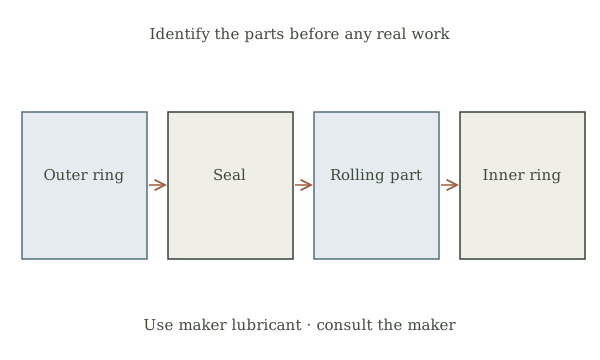
Identify inner ring, outer ring, rolling elements and any visible seal in a diagram. Stop at the conceptual stage if a trained operator, correctly guarded tool or material-specific instructions are unavailable.
- 03
Prepare
Find the maker’s lubricant, interval and serviceability guidance for the actual equipment model. Stop at the conceptual stage if a trained operator, correctly guarded tool or material-specific instructions are unavailable.
- 04
Compare
Turn only the free demonstrator by hand and note roughness without claiming a diagnosis. Stop at the conceptual stage if a trained operator, correctly guarded tool or material-specific instructions are unavailable.
- 05
Record
Record the correct service path or replacement part; keep contamination and excess grease out. Stop at the conceptual stage if a trained operator, correctly guarded tool or material-specific instructions are unavailable.
Mistakes to avoid
- Using an unknown material or fastener as though its rating were known
- Working around moving parts without isolation and guarding
- Treating the demonstration model as a specification
If it isn’t working
The part or material specification is missing
Leave the real assembly unaltered and obtain the maker’s service information or qualified advice before selecting a process.
A model does not behave as expected
Recheck dimensions, the intended motion and the source diagram; do not correct it by applying extra force to live equipment.
Then & now
Historical context
Plain and rolling bearings made wheels and shafts more durable; modern sealed units and selected lubricants limit maintenance.
The modern equivalent
Specified parts, documented service procedures, guarded machines and trained work provide the basis for real assemblies and repairs.
Sources & review
Editorial draft — specialist review pending. Written 2026-09-25. Sources support the stated scope; this page has not been professionally certified.
- SKF — Moving supports ↗
Primary safety, product or engineering reference for this conceptual method and limits. Checked 2026-09-25.
- SKF — Moving supports ↗
Primary safety, product or engineering reference for this conceptual method and limits. Checked 2026-09-25.