Why it matters
Serious blood loss can become fatal before professional help arrives. Calling and starting direct pressure promptly are useful immediate actions. Packing and tourniquets add specific skills that must be learned with appropriate equipment and supervised practice.
What you’ll need
Tools
- Phone
- Disposable gloves
Materials
- Gauze or clean cloth
- Bleeding-control kit selected through recognized training
- Training wound model for practice
Before you begin
Safety & limits
- For continuous heavy or spurting bleeding or shock signs, call local emergency services immediately and apply pressure. Do not delay to estimate a precise volume. Do not pull out embedded objects. Tourniquets and wound packing require recognized training or real-time emergency guidance; never rehearse them on a person.
Work carefully, in order
The method
- 01
Recognize and summon help
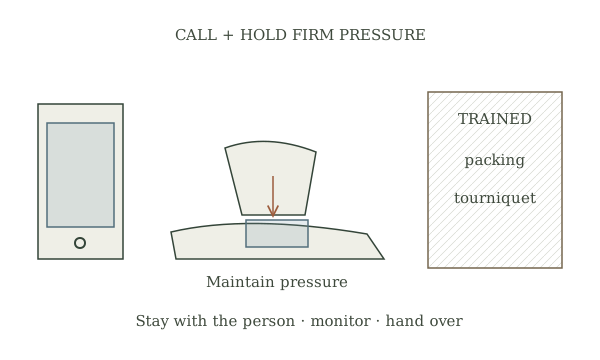
Check that approaching is safe. Treat rapidly pooling blood, heavy continuous flow or spurting as an emergency. Direct a named person to call and bring the kit, or call on speakerphone yourself. Give the exact location and say there is severe bleeding; do not wait for a measured quantity.
- 02
Find the bleeding point
Use gloves or a barrier when readily available without delaying care. Locate the source enough to press accurately. Ask a responsive injured person to press their own wound if helpful. Leave an embedded object in place and apply pressure around it, following dispatcher guidance.
- 03
Hold firm direct pressure
Place gauze or a clean cloth on the wound and press firmly and steadily. Keep pressure rather than repeatedly lifting the pad. Maintain it until bleeding stops, another responder takes over or an appropriate trained intervention controls it. Tell the dispatcher if blood continues despite pressure.
- 04
Escalate through trained care
For life-threatening limb bleeding, a trained responder may apply an appropriate tourniquet following training and device instructions. Packing is another trained technique for suitable wounds. Obtain real-time instructions if uncertain; do not replace either technique with a loose belt, thin cord or powder poured into the wound.
- 05
Monitor and hand over
Keep the person from becoming cold or overheated and watch breathing and responsiveness. Follow dispatcher positioning advice and report changes. Tell responders where the wound is, what was done and when any tourniquet was applied. Once applied, do not loosen or remove a tourniquet yourself.
- 06
Practise on training equipment
After the emergency, replace used supplies and arrange recognized bleeding-control instruction. Use a wound simulator and a clearly separate training tourniquet. Practise locating the kit, calling, holding pressure and handing over without constricting a volunteer’s limb. Have an instructor assess packing and device technique.
Mistakes to avoid
- Waiting to count blood loss
- Lifting the pad repeatedly
- Practising a real tourniquet on a volunteer
If it isn’t working
The first pad becomes soaked
Keep the original pad and firm pressure; follow dispatcher guidance and avoid building a thick stack that weakens pressure.
Pressure has not controlled the bleeding
Report this immediately and continue pressure while trained or dispatcher-guided escalation is arranged.
Then & now
Historical context
Modern bleeding-control education gives bystanders a defined role within emergency response. Improvised cords and household powders do not replace purpose-made equipment and training.
The modern equivalent
Recognized bleeding-control training, accessible gauze and purpose-made equipment integrated with emergency dispatch.
Sources & review
Editorial draft — specialist review pending. Written 2026-10-05. Sources support the stated scope; this page has not been professionally certified.
- American Red Cross — Life-Threatening External Bleeding ↗
Recognition, direct pressure, embedded objects, monitoring and trained escalation. Checked 2026-10-05.
- American College of Surgeons — Stop the Bleed Training ↗
Hands-on instruction and assessment in pressure, packing and tourniquet skills. Checked 2026-10-05.