Why it matters
Choking can change rapidly from a person coughing to being unable to breathe. Adults, children and infants need different positioning and techniques. A complete readiness exercise includes recognition, calling, practical assessment and the transition to CPR.
What you’ll need
Tools
- Phone
- Adult/child and infant training manikins with an instructor
Materials
- Current local course material
- Emergency contact and access sheet
Before you begin
Safety & limits
- For severe choking call local emergency services immediately and follow dispatcher guidance. Practise only on suitable manikins: back blows, abdominal thrusts and chest thrusts can injure healthy volunteers. Never perform blind finger sweeps or use abdominal thrusts on an infant.
Work carefully, in order
The method
- 01
Prepare age-specific practice
Arrange recognized training that includes the ages of people in your household. Set up adult/child and infant manikins and identify the local emergency number. Tell the instructor about accessibility needs. Rehearse assigning someone to call so the care sequence includes communication rather than technique alone.
- 02
Recognize the change
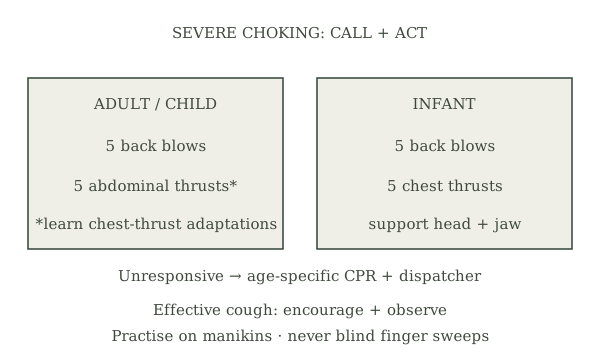
A person who can cough effectively or speak should be encouraged to cough while closely observed. A weak or absent cough, inability to speak or cry, or inability to breathe signals severe choking. Call emergency services and act promptly under training or dispatcher instructions; do not offer food or water.
- 03
Rehearse adult and child care
Under an instructor, practise supporting the person forward and giving five back blows between the shoulder blades. If obstruction remains, practise five abdominal thrusts with the fist above the navel, pulling inward and upward. Repeat the sequence while responsive. Learn chest-thrust adaptations for pregnancy or when the abdomen cannot be reached.
- 04
Rehearse the infant sequence
With the infant manikin, support the head and jaw face-down along the forearm, head below the body, and practise five back blows. Turn face-up while maintaining head support and practise five chest thrusts as taught in the current course. Repeat while needed. Never substitute abdominal thrusts or hang a baby upside down.
- 05
Practise loss of responsiveness
If the person becomes unresponsive, lower them safely to a firm surface and begin CPR according to age-specific training or the dispatcher. In practice, rehearse this transition on a manikin. Remove a mouth object only when clearly seen; a blind sweep can push an obstruction deeper.
- 06
Complete assessment and follow-up
Have the instructor check positioning, sequence and adaptations and arrange refreshers. After a real episode, obtain medical advice, especially after thrusts, persistent cough or swallowing difficulty. Record what happened and the care given. Review food preparation and small-object risks without treating an anti-choking gadget as a substitute for the response plan.
Mistakes to avoid
- Giving drinks during choking
- Using adult abdominal thrusts on an infant
- Rehearsing forceful manoeuvres on a friend
If it isn’t working
The person is coughing strongly
Encourage coughing and observe closely; be ready to call and act if the cough becomes ineffective.
The person becomes unresponsive
Move immediately to age-appropriate CPR and dispatcher guidance rather than continuing upright thrusts.
Then & now
Historical context
Modern choking guidance uses defined back-blow and thrust sequences instead of shaking a child or blindly searching the mouth. Recognized practical instruction is essential to learn the force and positioning.
The modern equivalent
Current recognized choking and CPR training with age-appropriate manikins and assessed practice.
Sources & review
Editorial draft — specialist review pending. Written 2026-10-05. Sources support the stated scope; this page has not been professionally certified.
- American Red Cross — Adult and Child Choking ↗
Effective cough, back blows and thrusts, adaptations and transition to CPR. Checked 2026-10-05.
- American Red Cross — Infant Choking ↗
Infant head support, back blows and chest thrusts, and no blind sweep. Checked 2026-10-05.