Why it matters
A wall scanner can help locate framing and hidden hazards before a project, but readings depend on wall material, depth, moisture and metal. Confirmation matters before anyone makes a hole.
What you’ll need
Tools
- Wall scanner with current instructions
- Pencil and removable tape
- Flashlight
Materials
- Ordinary accessible drywall wall
Before you begin
Safety & limits
- This is a non-invasive mapping exercise. Do not drill, cut or fasten from a detector reading alone. Scanners can miss live wiring, pipes and other objects; obtain drawings or a qualified inspection when a penetration is planned.
Work carefully, in order
The method
- 01
Identify the wall type
Choose a dry ordinary wall whose construction is known. Avoid tiled, foil-backed, plaster-and-lath or wet walls unless the scanner instructions explicitly support them. Check for outlets, plumbing fixtures and likely service runs.
- 02
Read the detector instructions
Select the correct mode and perform its startup or calibration steps as specified by the maker. Test the tool over a known location if possible and note the indicated depth and material limitations.
- 03
Scan from both directions
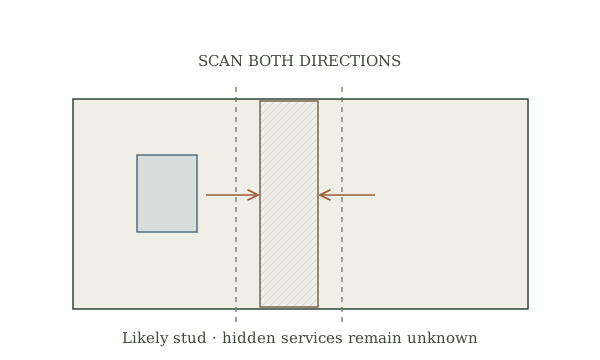
Move slowly across the surface with full contact as instructed. Mark the first and last response with removable tape, then approach from the opposite direction and compare the indicated center.
- 04
Cross-check the pattern
Repeat at a different height and compare with visible trim or fastener lines without assuming a fixed spacing. An unexpected broad or inconsistent signal may be metal, a pipe, moisture or a layered wall.
- 05
Record uncertainty
Sketch the likely framing and the uncertain zones. Remove temporary marks when done. Before any actual drilling project, use a separate hazard check and the load/fastener plan appropriate to the wall.
Mistakes to avoid
- Treating a single beep as proof of a stud
- Assuming no alarm means no wire
- Using a wood mode on an unsupported wall
If it isn’t working
Signal shifts between passes
Check contact, scan speed and wall compatibility; do not mark a confident center from unstable readings.
Broad or mixed signal
Treat the region as unknown and seek another method or a qualified survey before penetration.
Then & now
Historical context
Builders once found framing from exposed construction or measured regular stud spacing. Finished walls can conceal multiple layers, pipes and cables, so spacing alone is a poor safety test.
The modern equivalent
A professional wall survey and building records are appropriate for uncertain or high-consequence penetrations.
Sources & review
Editorial draft — specialist review pending. Written 2026-09-29. Sources support the stated scope; this page has not been professionally certified.
- Bosch Professional — GMS 120-27 Detector and FAQ ↗
Scanner mode, detection limits and circumstances where cables may be missed. Checked 2026-09-29.