Why it matters
Nut trees are a long-term landscape commitment. Hazelnut shrubs, chestnuts and walnuts differ greatly in size, winter hardiness, disease risk and pollination. The first useful skill is selecting a suitable species and a safe site, then documenting planting material and its likely mature footprint.
What you’ll need
Tools
- Tape measure
- Site map
- Notebook
Materials
- Local species guidance
- Nursery cultivar and provenance labels
Before you begin
Safety & limits
- Check utilities and mature branch clearance; do not plant large trees beneath wires or near structures.
- Do not eat unknown nuts or wild harvests; allergies can be severe.
Work carefully, in order
The method
- 01
Assess the site for decades
Map available sun, drainage, winter exposure, overhead clearance, property boundaries and the full mature crown and root area. Allow room for fallen nuts and maintenance without placing the tree above a path or parked vehicles. A compact hazelnut and a large walnut need very different sites.
- 02
Select an adapted species
Use local extension guidance for climate hardiness, soils, pests and disease resistance. Record species, cultivar, nursery provenance and expected mature form. Check local restrictions and invasive status before buying any nonnative planting stock; a fashionable tree may be poorly adapted.
- 03
Check pollination and harvest
Determine whether a compatible second cultivar or nearby tree is required and whether their flowering periods overlap. Plan where flowers and nuts may fall, how to collect them hygienically, and whether wildlife pressure or animals on the property require exclusion.
- 04
Plan establishment
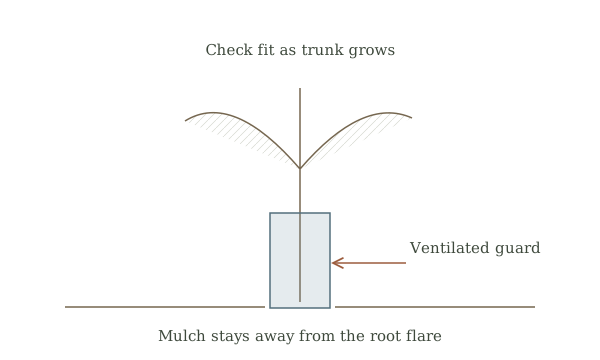
Use the companion fruit-tree planting guidance for root handling, planting depth, watering and mulch appropriate to the chosen stock. For a shrub form, use the species-specific establishment instructions instead. Stake only where needed and inspect ties so they do not girdle growing stems.
- 05
Track growth and reassess
Mark the planting on a permanent map with cultivar and date. Observe annual growth, winter damage, pollination and crop set. Follow species-specific pruning and pest guidance; do not use an apple-tree training plan on a hazelnut or walnut by default. Expect years before a useful crop.
Mistakes to avoid
- Planting a large tree in a small yard
- Assuming one cultivar will pollinate itself
- Expecting a reliable harvest immediately
If it isn’t working
A mature-size site is unavailable
Choose an appropriately sized shrub or defer planting rather than forcing a large tree into a hazardous position.
Flowers appear but no nuts form
Check cultivar compatibility, flowering overlap, plant maturity and local weather before adding fertilizer.
Then & now
Historical context
Nut-bearing trees and shrubs often occupied edges and larger homestead plots, providing a crop over many years after establishment.
The modern equivalent
Regional variety trials and nursery provenance records make long-term species selection more informed.
Sources & review
Editorial draft — specialist review pending. Written 2026-09-27. Sources support the stated scope; this page has not been professionally certified.
- UMN Extension — growing edible fruits and nuts ↗
Supporting reference; consult the original for species and local details. Checked 2026-09-27.
- OSU Extension — growing tree fruits and nuts at home ↗
Supporting reference; consult the original for species and local details. Checked 2026-09-27.