Why it matters
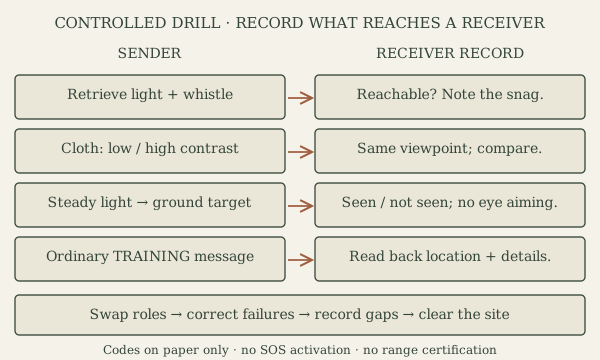
Knowing a code is different from reaching a receiver. This adult or supervised-learner drill uses a controlled daylight training area beside a dry refuge, with every participant in sight. Its measurable outcome is a completed sender/receiver record: equipment reached, a marker located, a steady light noticed and a message read back. Distress patterns are rehearsed silently indoors, never broadcast outdoors.
What you’ll need
Tools
- Whistle and headlamp
- Map, pencil and worksheet
- Phone for an ordinary message to the agreed partner
- Clock
Materials
- Spare contrasting cloth or tarp
- Dry shelter and layers
- Scenario cards: no reception, hidden marker, wind
Before this skill
- Emergency Signaling
Before you begin
Safety & limits
- Get permission for the training area and brief everyone who could mistake the activity for an emergency. Stop if unexpected observers, traffic, unsafe footing or poor weather invalidate the setup.
- No outdoor whistle distress pattern, SOS flashes, emergency calls, live beacon activation, flares, fire or laser. Sound codes remain written; the outdoor light test uses a steady beam at a ground target.
- Do not point a beam into eyes or practice toward aircraft, vehicles or water users. The leader sets a safe training boundary and remains with the group.
- This daylight exercise does not validate nighttime, fog, storm or long-distance visibility. Stop and return to the refuge if cold, wetness or fatigue develops.
Work carefully, in order
The method
- 01
Agree the boundary, roles and worksheet
Choose a permitted level area with a known exit and dry refuge. Assign sender, receiver and leader; keep them within ordinary speaking distance, with an unobstructed view. On paper make columns for channel, action, receiver observation and correction. Write “TRAINING ONLY” at the top. State the stop word and rehearse it by ordinary speech. If any observer could misread the setup, keep the whole exercise indoors.
- 02
Retrieve equipment from the real packing position
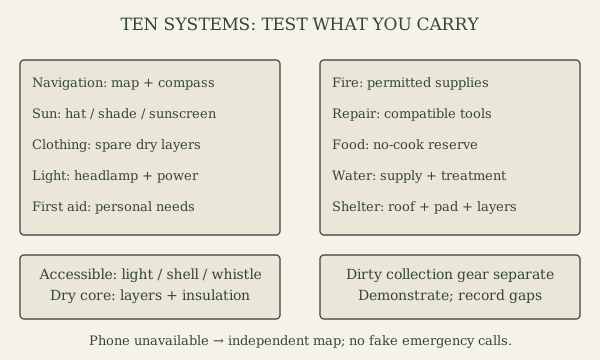
With normal layers and pack on, bring the whistle and light into use without emptying the pack. Check the whistle for damage and read the light’s controls; do not sound a distress pattern. Switch the light on normally and identify its spare power. Record any retrieval snag and move the equipment to an accessible, secure position. Repeat until the partner can see that each item is reachable without abandoning the pack.
- 03
Compare two marker placements
Use spare fabric that is not needed for warmth. Place it first against similar-colored ground, then against a contrasting background within the boundary; hold or secure it so it cannot blow away. The receiver stays at one agreed point and reports whether they can locate each placement and what obscures it. Sketch both arrangements. Change only one feature at a time. These two observations demonstrate contrast and obstruction, not a certified detection range.
- 04
Test light aiming; write the distress codes
Aim a steady headlamp beam at a ground target beside the receiver, away from their eyes. The receiver reports whether the light is noticeable; if daylight prevents detection, record “not detected” rather than inventing success. Move to a sheltered indoor setting if needed. On paper write the NPS SOS groups and its three-blast whistle example, then the Scottish six-signal convention. Explain which guidance you would check before a trip. Do not perform either distress pattern outdoors.
- 05
Read back the report and inject a failure
Send an ordinary practice message only to the consenting partner, beginning “TRAINING ONLY — no emergency.” Include fictional location, group size, condition and callback arrangement. The receiver reads it back; correct missing coordinate format or vague location. Next the leader supplies a “no reception” card: describe a device-specific backup and the shelter/signaling plan, without pressing SOS. A manufacturer self-test follows its manual separately. No acknowledgment remains an unresolved communication result.
- 06
Swap roles, correct failures and pack away
Swap sender and receiver and repeat any failed retrieval, contrast or message check. Completion requires both learners to retrieve their equipment, distinguish the regional patterns on paper, describe the receiver’s actual observation and read back the report accurately. Record the remaining gap if daylight light visibility failed. Remove the marker, restore the site and tell all participants the drill has ended. Book further supervised practice for any unresolved skill; the worksheet is not a rescue qualification.
Mistakes to avoid
- Testing a beacon by pressing its emergency activation control
- Running a public distress pattern because it is only practice
- Calling an undetected daylight beam a successful signal
- Changing the observer position and marker together so the comparison is unclear
If it isn’t working
An uninformed passerby arrives
Stop immediately, put signaling gear away and explain the controlled exercise in ordinary speech. Continue only when the leader can maintain the permitted setup without misleading anyone; otherwise use the indoor worksheet.
The receiver cannot see the light in daylight
Record the limitation. Check the normal controls and aim at a safe ground target indoors, or plan a separately supervised low-light session. Do not increase risk to force a successful result.
The message contains location numbers but no format
Have the sender add the coordinate format shown on the training map or device and identify the point as fictional. The receiver must read back the whole location before marking the communications check complete.
Then & now
Historical context
The NPS preparedness tradition combines whistles, mirrors and visible shelter with a written emergency plan. NOAA’s 1982 first satellite rescue marks a later alert system. This modern teaching exercise compares those channels; it does not claim to reproduce a particular historical survival tradition.
The modern equivalent
Carry a printed drill record and practice the exact equipment you take. Real coverage, weather and responder acknowledgment require destination planning and device-specific instruction; a short controlled exercise proves only its recorded observations.
Sources & review
Editorial draft — wilderness instructor review pending. Written 2026-10-14. Sources support the stated scope; this page has not been professionally certified.
- NPS — Outdoor Emergency Plan ↗
Help reports, staying at the reported location unless immediately threatened, visible shelter and energy conservation. The receiver cards, worksheet and practice distances are original teaching exercises, not rescue performance standards. Checked 2026-10-14.
- NPS — Outdoor Emergency Plan, printable card ↗
Three whistle blasts with a break before repeating; flashlight SOS as three short, three long, three short flashes. These are the NPS conventions used in the US-oriented worked example, not a claim of worldwide uniformity. Checked 2026-10-14.
- Mountaineering Scotland — Calling for help ↗
Contrasting Scottish mountain-rescue advice: six whistle blasts or torch flashes repeated every minute. Local emergency channels and conventions must be checked for the destination. Checked 2026-10-14.
- NOAA SARSAT — Frequently Asked Questions ↗
406 MHz beacon registration, manufacturer-directed self-test, false-alert notification and the first Cospas-Sarsat rescue in 1982. A beacon alert or test does not certify rescue arrival or an ordinary message delivery. Checked 2026-10-14.