Why it matters
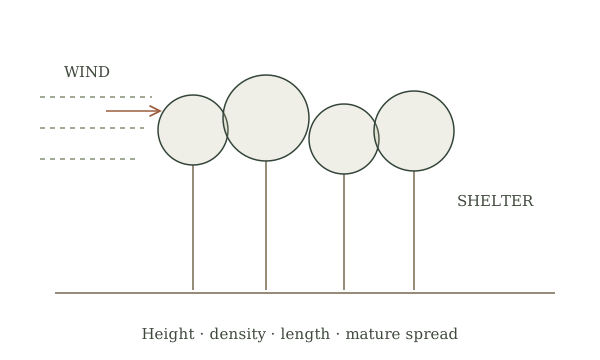
A windbreak changes airflow, snow deposition and habitat over many years. Its location can protect a garden or building while shading crops or drifting snow onto a route if planned poorly. Height, density and length matter more than simply planting a dense line.
What you’ll need
Tools
- Site map
- Wind observations
- Measuring tape
Materials
- Locally suitable trees and shrubs
- Mulch and water for establishment
Before you begin
Safety & limits
- Locate overhead and underground utilities before choosing a row or digging. Keep future mature growth away from lines and access routes.
- Consult local specialists for wind, snow, fire exposure and species choices; avoid invasive plants and maintain sight lines near roads.
Work carefully, in order
The method
- 01
Define the protection target
Mark the home, garden, livestock area or field edge to shelter. Record the damaging wind direction over more than one season and ask where snow would accumulate downwind. A screen for privacy may need a different arrangement from a working farm windbreak.
- 02
Map constraints at maturity
Show utilities, roads, gates, drainage, sunlight and the mature height and spread of each candidate species. Leave access for pruning, replacement and equipment. Check that shade or roots will not displace an orchard, garden or neighboring use.
- 03
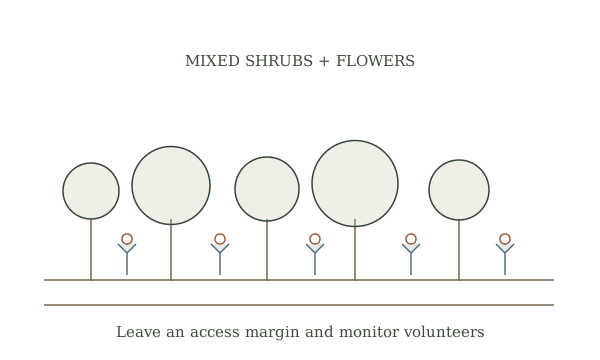
Choose a diverse structure
Discuss locally suitable trees and shrubs with extension or conservation staff. Mix appropriate species so loss of one does not open the whole screen. Consider the desired porosity and height rather than assuming a solid wall always offers better shelter.
- 04
Plan establishment care
Arrange weed control, moisture and mulch while young plants establish. Protect new stems where deer or livestock browse. Keep a record of species and planting position, and allow for replacement rather than crowding plants to compensate for early losses.
- 05
Reassess the effect
Check plant survival, gaps, drifting snow, shade and wind at the protected area after successive seasons. Adjust maintenance within the design; a windbreak is a long-term living system rather than a one-day installation.
Mistakes to avoid
- Planting beneath power lines
- Using one susceptible species for every row
- Ignoring downwind snow and shade
If it isn’t working
A gap develops
Identify whether wind, water, browsing or disease caused it before choosing a replacement.
Snow collects on a path
Review placement and design with a local windbreak adviser; do not add another row by guesswork.
Then & now
Historical context
Farm shelterbelts grew from long observation of wind and snow. Diverse modern plantings improve resilience when one species fails.
The modern equivalent
Conservation-service windbreak design tools can model target, species and site conditions.
Sources & review
Editorial draft — specialist review pending. Written 2026-09-28. Sources support the stated scope; this page has not been professionally certified.
- University of Minnesota Extension — Windbreaks ↗
Purpose and main design elements. Checked 2026-09-28.
- University of Minnesota Extension — Selecting trees and shrubs for windbreaks ↗
Species diversity and site selection. Checked 2026-09-28.