Why it matters
Bark protects living tissue, and resin may be part of a tree's response to injury or insects. Their appearance can help observation but is not a reliable species, disease or food identification on its own. Removing bark or opening new wounds for a sample can harm a tree.
What you’ll need
Tools
- Camera
- Notebook
Materials
- Naturally fallen bark, if collection is allowed
Before you begin
Safety & limits
- Do not carve, girdle, tap or peel a living tree. Check land rules before collecting bark or sap.
- Do not ingest, apply to skin as a treatment or burn unknown resin; irritation and fire hazards vary.
Work carefully, in order
The method
- 01
Observe an intact tree
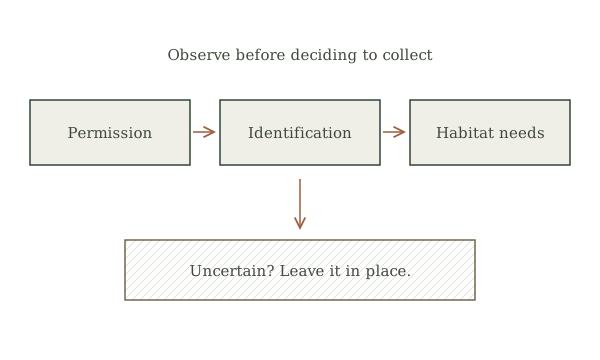
From a path, note bark texture, fissures, color and whether resin is already present. Photograph the whole tree and its leaves or needles, cones and setting so a later identification has context. Do not scrape bark to reveal a fresh layer.
- 02
Compare natural pieces
If collection is permitted, inspect a small piece that has already fallen. Compare its outer weathered surface and inner face without removing material from a living trunk. Leave large bark pieces that shelter insects or cover soil.
- 03
Record resin cautiously
Note the position and shape of an existing resin deposit without touching or enlarging it. Resin alone cannot diagnose a beetle or other disease; wounds and other causes may produce similar signs. Ask a local tree specialist about a changing or widespread problem.
- 04
Consider collection impacts
Find out whether the land manager requires a permit for bark, sap or other forest products. Do not assume that a small amount is exempt. A living tree's bark is protective tissue, and repeated sampling can accumulate damage.
- 05
Keep uses within evidence
Label any permitted natural sample as an observation piece. Historical adhesives, finishes or fire starters involve species-specific processing and hazards; use a dedicated, reviewed process rather than experimenting with unknown material.
Mistakes to avoid
- Peeling living bark to identify a tree
- Treating resin as proof of one pest
- Assuming natural means edible or skin-safe
If it isn’t working
Sticky material is widespread on a tree
Record the entire tree and other symptoms and consult local extension or an arborist.
A sample's identity is uncertain
Keep it for visual study only and do not process it.
Then & now
Historical context
Bark and resin had many historic material uses. Those practices depended on species, season, ownership and specialized stewardship; this guide does not teach extraction or medicinal use.
The modern equivalent
Tree diagnostics combine multiple features and professional assessment; manufactured materials have known specifications.
Sources & review
Editorial draft — specialist review pending. Written 2026-09-28. Sources support the stated scope; this page has not been professionally certified.
- National Park Service — Leave No Trace ↗
Protect live trees and plants. Checked 2026-09-28.
- US Forest Service — Special forest products permits ↗
Bark and sap can be regulated forest products. Checked 2026-09-28.
- National Park Service — Signs of spruce bark beetles ↗
Resin alone is not diagnostic. Checked 2026-09-28.