Why it matters
Finding something useful does not establish ownership, permission, identification or ecological abundance. A responsible collecting trip may end with notes and photographs instead of a bag of materials. This guide concerns the decision process, not permission to forage or instructions for eating wild plants.
What you’ll need
Tools
- Notebook
- Camera
- Local identification reference
Materials
- Land-manager guidance
Before you begin
Safety & limits
- No edible plant or mushroom identification is provided here. Follow local rules and respect protected places and cultural sites.
Work carefully, in order
The method
- 01
Establish whose rules apply
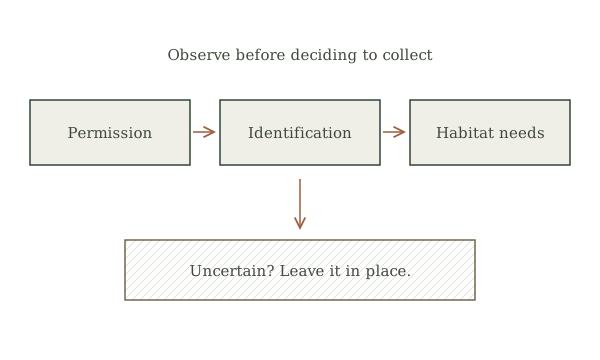
Identify the land manager and ask about the exact material, location, amount and intended use. Keep the response or permit with your trip notes. Access to a trail is not the same as permission to collect nearby. When the answer is unclear, postpone collection rather than treating silence as consent.
- 02
Define the need before the trip
Write down the project and the small quantity it actually requires. Consider whether garden prunings, purchased material or something already stored would do the job. An open-ended search for useful things makes it easy to collect more than can be used and difficult to explain why removal is necessary.
- 03
Identify without consuming
Use reliable local references and appropriate expert help where identification matters. Photograph unknown plants or fungi in place. Do not taste a specimen to identify it, and do not treat this general guide as an edible-species guide. Record uncertainty explicitly instead of relying on resemblance to an online photograph.
- 04
Prefer leaving habitat intact
Even dead material can have an ecological role. Avoid living bark, nesting sites, culturally significant objects and scarce or slowly replenished material. Leave natural objects in place in protected recreation areas unless the manager explicitly permits collection. A small amount taken by many visitors can become a substantial loss.
- 05
Close the decision and record it
If collection is explicitly allowed and appropriate, stay within its conditions and record what was taken and where. Check local guidance before transporting material that could carry pests. If you decide to leave it, record that too. A useful field record explains the decision, not just the contents of a bag.
Mistakes to avoid
- Assuming fallen means free to take
- Using a fixed percentage as a universal sustainable harvest rule
- Treating online resemblance as safe edible identification
If it isn’t working
The manager’s guidance is unclear
Ask a precise follow-up naming the material and location; defer collection until permission is established.
The material is less common than expected
Leave it and reconsider the project or source. Your original estimate is not an obligation to harvest.
Then & now
Historical context
Traditional gathering often depended on place-specific knowledge and community rules. A modern visitor should not assume that a general tradition grants access or permission.
The modern equivalent
Photographs, local conservation guidance and purchased alternatives can meet a project’s needs with less disturbance.
Sources & review
Editorial draft — sources checked; specialist review pending. Written 2026-09-20. Sources support the stated scope; this page has not been professionally certified.
- Leave No Trace — leave what you find ↗
Protecting living plants, natural objects and cultural sites; observation is the default on public land. Checked 2026-09-20.