Why it matters
Charcoal powered older ironworking and cooking, but making it involves long-lived hot material, smoke and carbon monoxide. Historic interpretation is safest as an observation skill.
What you’ll need
Tools
- Historic site interpretation
- Notebook
Materials
No additional materials.
Before you begin
Safety & limits
- This is a historical overview, not a kiln plan. Do not attempt earth-mound or barrel charcoal production. Never use charcoal indoors or in enclosed spaces; follow site access rules around ruins.
Work carefully, in order
The method
- 01
Locate the setting
Use a museum or land-manager interpretation of a documented kiln site. Stay on designated paths and do not enter unstable historic structures.
- 02
Trace the material flow
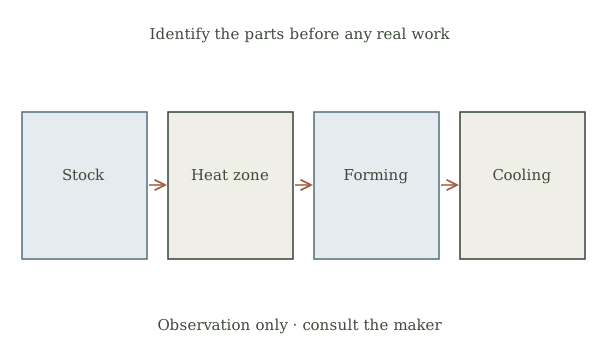
Identify where wood came from, how workers loaded a kiln and where finished charcoal was carried. Consider the woodland demand and transport labor.
- 03
Describe the chemistry broadly
Heating wood with limited oxygen drives off water and volatile compounds and leaves a carbon-rich residue. It is not the same as simply letting an open campfire go out.
- 04
Identify the hazards
Note that kilns, charcoal and ash can retain dangerous heat and release carbon monoxide. Historic operation depended on skilled crews and does not translate to a backyard instruction.
- 05
Compare modern practice
Record how current industrial equipment, emissions controls and workplace safety differ. For ordinary cooking, use commercially made fuel outdoors in an approved appliance.
Mistakes to avoid
- Mistaking a historic kiln for a DIY design
- Assuming cold-looking charcoal is safe to handle
- Using charcoal in a shelter
If it isn’t working
Site lacks interpretation
Use the linked land-manager history instead of entering or examining ruins.
Charcoal remains from a fire
Treat it as hot until fully extinguished under local guidance.
Then & now
Historical Method — Modern Safety Practices Differ
Historical context
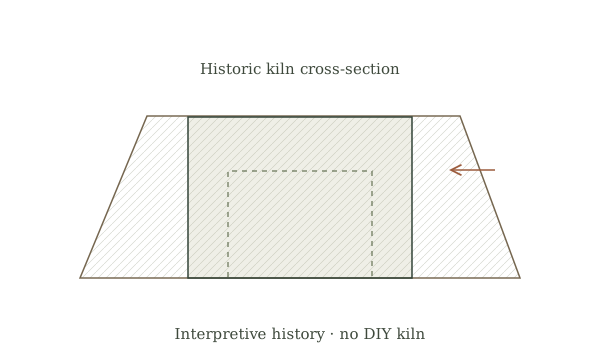
Colliers tended earth-covered mounds and later built kilns that restricted air while wood was heated; surviving kilns show the scale and labor of this work.
The modern equivalent
Commercial charcoal production uses engineered equipment and regulated controls; the historical skill is useful for material literacy.
Sources & review
Editorial draft — specialist review pending. Written 2026-09-27. Sources support the stated scope; this page has not been professionally certified.
- US Forest Service — Charcoal Kilns Interpretive Site ↗
Supporting reference; follow the original and local rules for complete instructions. Checked 2026-09-27.
- US EPA — Burn Wise Facts, Figures and Safety Tips ↗
Supporting reference; follow the original and local rules for complete instructions. Checked 2026-09-27.
- Smokey Bear — Campfire safety ↗
Supporting reference; follow the original and local rules for complete instructions. Checked 2026-09-27.