Why it matters
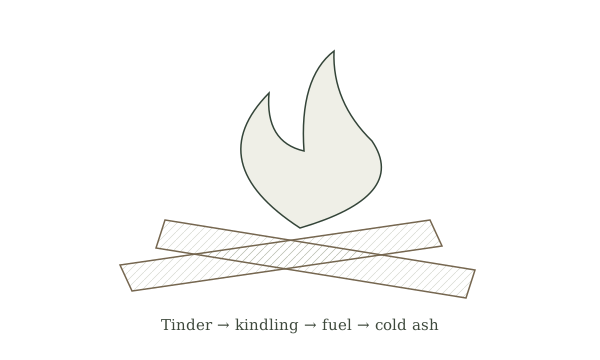
The triangle helps explain ignition and extinction, but an outdoor fire also responds to wind, moisture, fuel size and weather. It is a mental model, never a promise that a small fire will remain controllable. Hidden embers retain heat after visible flames fade, so observation alone cannot establish that a fire is safe to leave.
What you’ll need
Tools
- Paper and pencil
Materials
- Three labeled cards
Before you begin
Safety & limits
- Keep this exercise conceptual. Never test fire suppression on an uncontrolled fire; leave and call emergency services when a fire escapes.
Work carefully, in order
The method
- 01
Name the three needs
Draw a triangle and label fuel, heat and oxygen. A flame persists only while usable fuel is heated enough and oxygen reaches the reaction.
- 02
Trace an ordinary example
Use a stove or permitted campfire as a thought exercise. Identify the fuel, an ignition source and the air route without lighting anything for the exercise.
- 03
Consider interruptions
Imagine withdrawing fuel or reducing heat with the appropriate approved method. Removing one side may interrupt combustion, but hot embers can reignite.
- 04
Add the missing context
Note wind, dry surroundings, smoke and the difference between flame and residual heat. The triangle does not specify how to extinguish a real fire.
- 05
Connect to prevention
Keep combustibles away from heat, follow local restrictions and learn the correct extinguishing method for the setting before any supervised practice.
Mistakes to avoid
- Treating the diagram as an extinguishing procedure
- Assuming no visible flame means no heat
If it isn’t working
Embers remain warm
Keep the area attended and use the approved extinguishing procedure.
Then & now
Historical context
The three-part model has long been used in fire education; modern fire science also describes the sustaining chemical chain reaction.
The modern equivalent
Fire safety instruction also uses the fire tetrahedron to include the sustaining chemical reaction.
Sources & review
Editorial draft — specialist review pending. Written 2026-09-27. Sources support the stated scope; this page has not been professionally certified.
- US Fire Administration — Fire Safety Trailer Curriculum ↗
Supporting reference; follow the original and local rules for complete instructions. Checked 2026-09-27.
- National Park Service — Campfires ↗
Supporting reference; follow the original and local rules for complete instructions. Checked 2026-09-27.