Why it matters
Earth construction has many regional forms. Learning the material and water paths is more useful than copying a universal recipe. A small educational specimen can reveal drying changes, but cannot qualify a soil mix for structural use.
What you’ll need
Tools
- Notebook and specimen labels
- Small tray and reusable model mould
- Ruler and camera
Materials
- Clean teaching material supplied by a tutor
- Covered drying space
- Existing building photographs
Before this skill
- Shed Planning Principles
Before you begin
Safety & limits
- Keep this exercise to small, nonstructural teaching specimens. Avoid contaminated soil and inhaling dry dust; use tutor-specified protection. Do not excavate foundations, remove finishes or repair load-bearing earth walls. Bulging, wet or unstable walls need an earth-building specialist and structural assessment.
Work carefully, in order
The method
- 01
Identify the construction form
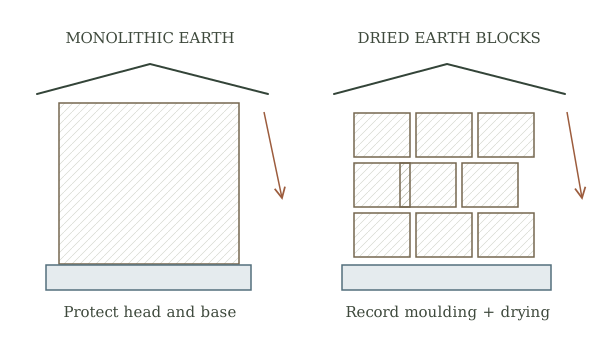
Compare documented photographs of a continuous earth wall and moulded adobe blocks. Record visible joints, protective base and finish. A rendered face may conceal the material, so mark uncertain identification. Do not remove coatings to find out what lies behind them.
- 02
Describe the teaching material
With a tutor, record the source and constituents of a clean sample, including any fibre. Label each specimen and the preparation used. Soil varies; neither a jar test nor a hand-rolled ball establishes structural suitability. Keep the notes attached to the specimen throughout drying.
- 03
Compare shapes while drying
Use the same tutor-prepared material for a small hand-formed piece and a moulded block on a tray. Photograph and measure them before drying, then record changes over several days. Observe shrinkage, edges and cracks without forcing drying with heat. The comparison is educational, not a strength test.
- 04
Map water protection
On a building sketch, mark roof drainage, exposed wall heads, ground contact and the protective base. Document visible dampness and coating failures. Ask how the finish permits drying and remains compatible with the earth; do not assume a harder waterproof coating is a repair.
- 05
Plan specialist care
Assemble the photographs, specimen record and unresolved questions. Ask an experienced earth-building practitioner to assess material compatibility, structural stability and local approvals. Agree a maintenance schedule for roof outlets, wall bases and finishes before considering any replacement or new construction.
Mistakes to avoid
- Using garden topsoil as an assumed building mix
- Treating a dry specimen as a structural test
- Sealing a damp earth wall without assessing drying
If it isn’t working
The specimen shrinks or cracks
Record the material, drying conditions and changes; discuss them with the tutor rather than adopting an untested mix adjustment.
The wall base is wet or eroding
Keep clear of unstable areas and request assessment of drainage, ground contact and compatible repair.
Then & now
Historical context
Cob names a family of monolithic earth traditions; adobe commonly uses moulded, dried earth blocks. Both require knowledge of local material and maintenance, and surviving examples reflect particular climates and care.
The modern equivalent
Tested earth-building systems and conservation plans developed for the actual soil, climate and structure.
Sources & review
Editorial draft — specialist review pending. Written 2026-09-30. Sources support the stated scope; this page has not been professionally certified.
- SPAB — Unbaked Earth Walling ↗
Cob traditions, water damage and conservation of earth walls. Checked 2026-09-30.
- National Park Service — Earthen Architecture: Preservation Techniques ↗
Adobe moulding and drying, moisture deterioration and specialist maintenance at Tumacácori; site-specific practice. Checked 2026-09-30.