Why it matters
A compass points toward magnetic north, while a map may reference true or grid north. The difference must be handled deliberately using current local information. A bearing gives direction, not a safe route through cliffs, water, fences, or private land.
What you’ll need
Tools
- Baseplate compass
- Current topographic map
Materials
- Known open practice area
Before you begin
Safety & limits
- Practice near known routes. This page is not sufficient preparation for remote travel.
Work carefully, in order
The method
- 01
Choose safe practice
Use a familiar park or open field with visible landmarks and an easy return. Tell someone your plan. Keep the compass away from phones, vehicles, metal tables, and power sources that can disturb the needle.
- 02
Read the map references
Locate north markings, scale, legend, and date. Obtain the current magnetic declination for the area and learn how your compass applies it. A printed declination diagram can be outdated; do not guess the correction sign.
- 03
Orient the map
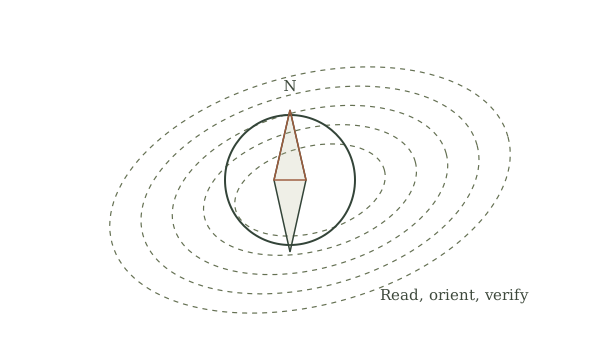
Set the compass according to its instructions and turn the map until its north reference is correctly aligned. Compare at least two visible features to the map. If they disagree, resolve the mismatch before moving.
- 04
Take a short bearing
Place the baseplate from your known position to a nearby target and set the dial using the map’s north lines. Apply declination correctly. Hold the compass level, align the needle as instructed, and identify a visible intermediate landmark in the travel direction.
- 05
Walk and verify
Walk to the landmark while watching terrain, then stop and recheck position. Use mapped features and distance as independent checks. If uncertain, stop early, return to the last confirmed point when safe, and reassess rather than pushing farther into uncertainty.
Mistakes to avoid
- Ignoring magnetic declination
- Holding the compass beside a phone
- Following a bearing through unsafe terrain
If it isn’t working
Needle changes near equipment
Move away and recheck.
Map and ground disagree
Confirm location, orientation, and map version before continuing.
Then & now
Historical context
Compass work complements rather than replaces observation and map reading.
The modern equivalent
GNSS navigation is useful, but batteries, reception, map quality, and route judgment still matter.
Sources & review
Editorial draft — specialist review pending. Written 2026-09-20. Sources support the stated scope; this page has not been professionally certified.
This entry describes general practice. A topic-specific source review is still required before it can be marked reviewed.
How this manual handles evidence →