Why it matters
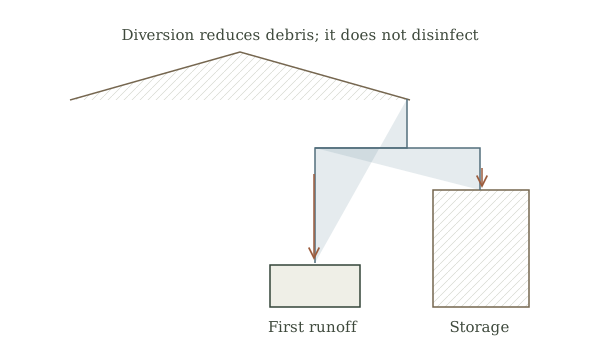
The first rainfall can carry roof debris, droppings and other contaminants. A diverter reduces some incoming material but does not disinfect water or establish potability; the required diverted volume depends on the roof and system.
What you’ll need
Tools
- System sketch
- Inspection log
Materials
- Existing roof catchment diagram
Before this skill
- rainwater-collection
Before you begin
Safety & limits
- Do not drink untreated collected rainwater. Keep nonpotable plumbing separate from potable supply. Use a qualified designer for sizing, backflow protection and any connection to a building.
Work carefully, in order
The method
- 01
Trace the catchment
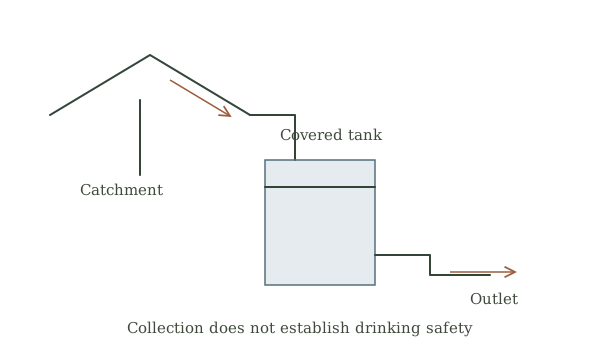
Sketch the roof, gutters, debris screen, first-flush path, storage inlet and overflow on an existing system. Mark which outlets are nonpotable.
- 02
Identify what is diverted
The device sends the initial roof runoff away from storage, so leaf litter, dust, droppings and other material are less likely to enter the tank. It cannot remove every hazard.
- 03
Inspect without opening tanks
From safe ground, look for blocked screens, standing discharge, leaks and a diverter that fails to reset between storms. Do not climb a roof or enter a tank.
- 04
Plan maintenance and testing
Use the manufacturer's and local authority's guidance for draining, cleaning and sizing. Record service and seek qualified advice about water testing for the proposed use.
- 05
Keep uses separate
Label outlets and keep the collected supply out of drinking, cooking and bathing unless a locally approved treatment and verification plan establishes suitability.
Mistakes to avoid
- Calling diverted rain potable
- Sizing by a universal rule without roof area
- Letting a blocked diverter overflow at a foundation
If it isn’t working
Storage fills with debris
Check screen and diverter maintenance with the system off and appropriate help.
Discharge ponds near a wall
Route the outlet through a qualified drainage plan.
Then & now
Historical context
Roof catchment systems have long used screens, settling and diversion to protect storage, while modern guidance stresses testing and separation of uses.
The modern equivalent
Modern packaged diverters still need inspection, drainage and an independently verified water-use plan.
Sources & review
Editorial draft — specialist review pending. Written 2026-09-27. Sources support the stated scope; this page has not been professionally certified.
- CDC — Collecting Rainwater and Your Health ↗
Supporting reference; consult the original and current local requirements for complete guidance. Checked 2026-09-27.
- US EPA — Rainwater Harvesting Practices ↗
Supporting reference; consult the original and current local requirements for complete guidance. Checked 2026-09-27.