Why it matters
A large package often gets thawed for one small meal. Dividing it before freezing reduces waste and repeated handling. Tight, appropriate packaging slows drying and freezer burn; it does not make mishandled food safe. A written inventory helps use older packages while they are at their best quality.
What you’ll need
Tools
- Freezer thermometer
- Clean board and knife
- Marker
- Tray
Materials
- Fresh properly chilled raw meat or fish
- Freezer-suitable bags or wrap
- Labels
Before this skill
- Handling Raw Meat and Poultry
- Handling Fresh Fish
- Freezing and Thawing Food
Before you begin
Safety & limits
- Freeze only food that has been handled and kept cold appropriately; freezing does not erase contamination or an earlier warm interval.
- Separate raw products and clean surfaces and hands between products. Do not treat vacuum-sealed fish as a shelf-stable food; follow package-specific thawing instructions because reduced-oxygen packaging creates distinct hazards.
- Keep a freezer at the official recommended temperature; choose product-specific quality windows from the cold-storage chart rather than assuming all packages age alike.
Work carefully, in order
The method
- 01
Decide how it will be used
Plan ordinary meal sizes and future cooking methods before opening bulk packages. Check that the product has remained properly cold and that the freezer thermometer reports the target range. Set up labels and suitable moisture-resistant packaging so raw food need not wait on the counter while supplies are found.
- 02
Make manageable portions
With clean hands and a dedicated raw-food board, separate whole cuts or fillets into the amounts you actually cook. Keep other packages chilled during the task; use a tray to catch juices. Make a record for each species and form, particularly when dividing ground meat, poultry or fish.
- 03
Wrap and exclude excess air
Use packaging rated for the freezer and follow its directions. Wrap closely or press air out of a suitable freezer bag before sealing, leaving any expansion space the product requires. Double-wrap sharp bones to protect the seal. Vacuum packaging can reduce air exposure but adds fish-specific thawing constraints and never creates room-temperature stability.
- 04
Label and arrange
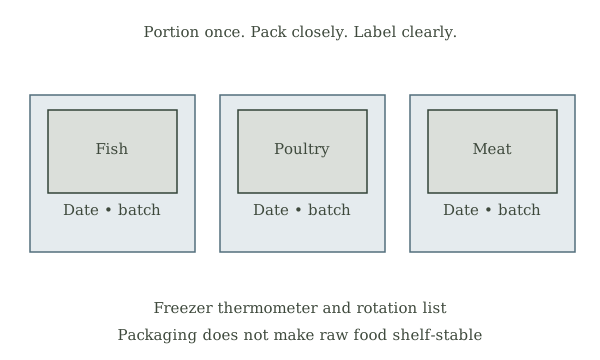
Write product, portion, packing date, source or lot if available, and any key preparation note on each package. Freeze in a single layer when space permits, then group products once solid so air can circulate. Update a freezer list and place older suitable packages where they will be used first.
- 05
Thaw with a plan
Choose a package ahead of time and thaw under refrigeration according to current government and manufacturer instructions. Put raw food in a tray below ready-to-eat food. A vacuum-packed fish label may call for removing the package before thawing; follow that label or a seafood safety authority. Cook to the appropriate product-specific guidance.
Mistakes to avoid
- Freezing an oversized package that must later be thawed for one portion.
- Assuming a vacuum seal keeps fish safe at room temperature.
- Discarding the original source and date when repacking.
If it isn’t working
A package has frost or freezer burn
Check whether its wrapping leaked and use official guidance for quality and safety; repackage intact remaining frozen portions correctly rather than assuming the frost identifies a pathogen.
A freezer lost power
Keep its door closed and use current government outage guidance based on measured conditions; do not use taste as a deciding test.
Then & now
Historical context
Icehouses and seasonal slaughter demanded careful allocation of perishable food. A modern freezer offers steady temperature and household-scale portions, while a simple label replaces much guesswork about age and origin.
The modern equivalent
A labeled freezer inventory and reliable thermometer make food rotation practical while published charts supply the product-specific cold-storage limits.
Sources & review
Editorial draft — specialist review pending. Written 2026-09-24. Sources support the stated scope; this page has not been professionally certified.
- FoodSafety.gov — cold food storage chart ↗
Freezer temperature and product-specific quality windows. Checked 2026-09-24.
- FDA — selecting and serving fresh and frozen seafood safely ↗
Wrapping and freezing fish, keeping it cold and safe thawing methods. Checked 2026-09-24.
- FDA — safe food handling ↗
Freezer and refrigerator temperatures and raw-food separation. Checked 2026-09-24.


