Why it matters
Sunlight, area, temperature, wind and condensation surfaces affect output; a small passive still can produce little water and cannot be assumed to meet daily needs. Collection hygiene and source contaminants require separate assessment.
What you’ll need
Tools
- Diagram
- Water-needs plan
Materials
- Reliable drinking-water source for comparison
Before this skill
- water-treatment-methods
Before you begin
Safety & limits
- Never count on a makeshift solar still as the sole drinking-water source. Do not use water contaminated by fuels, solvents or unknown chemicals; volatile contaminants and dirty collection surfaces defeat simple safety assumptions. Seek tested supply and emergency help.
Work carefully, in order
The method
- 01
Sketch the cycle
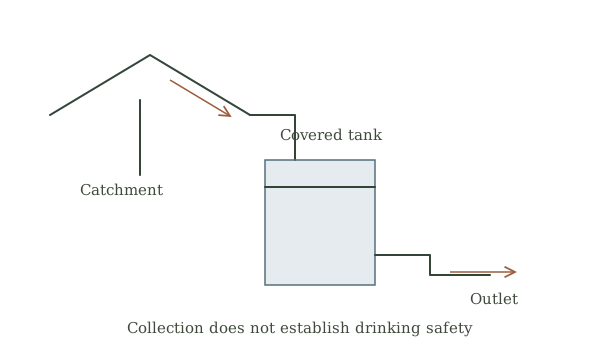
Draw a sunlit source, evaporation space, cooler condensing surface and clean collection vessel. Note that transfer of vapor is different from filtering a liquid.
- 02
List the dependencies
Record which parts rely on strong sunlight, exposed area, temperature difference and a clean path for condensate. Cloud, shade and leaks change performance.
- 03
Keep yield uncertain
Do not borrow a claimed output from another design or location. Experimental stills vary; a tiny improvised device is not a measured supply for a person.
- 04
Check the source and collection
Salt can remain behind during distillation, yet contaminants that vaporize or enter from dirty surfaces remain a concern. Appropriate testing and treatment depend on the source.
- 05
Choose a dependable plan
Carry or store verified drinking water, know official local treatment advice and arrange resupply. Treat a still as a demonstration of a principle, not an emergency guarantee.
Mistakes to avoid
- Assuming clear condensate is automatically safe
- Relying on a sunny-day claim in cloudy weather
- Using an unknown chemical source
If it isn’t working
Little water condenses
Do not extend the experiment into an emergency plan; obtain a verified supply.
Source has an unknown contaminant
Do not consume the output without qualified water-quality advice.
Then & now
Historical context
Solar distillation echoes the water cycle: water evaporates from a saline source and condenses elsewhere, leaving much dissolved salt behind.
The modern equivalent
Engineered desalination systems monitor capacity and water quality; a passive demonstration cannot substitute for them.
Sources & review
Editorial draft — specialist review pending. Written 2026-09-27. Sources support the stated scope; this page has not been professionally certified.
- USGS — Desalination ↗
Supporting reference; consult the original and current local requirements for complete guidance. Checked 2026-09-27.
- Solar still performance review (indexed by PubMed) ↗
Supporting reference; consult the original and current local requirements for complete guidance. Checked 2026-09-27.
- CDC — Collecting Rainwater and Your Health ↗
Supporting reference; consult the original and current local requirements for complete guidance. Checked 2026-09-27.