Why it matters
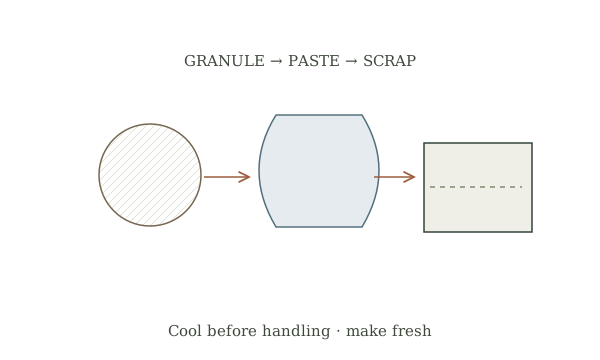
Starch granules swell and thicken when heated in water. The resulting paste can bind ordinary paper temporarily, but moisture, mold and aging make material choice and storage important.
What you’ll need
Tools
- Small saucepan
- Whisk
- Clean brush
Materials
- Food-grade starch
- Water
- Scrap paper
Before you begin
Safety & limits
- Keep hot paste away from skin. Prepare only a tiny fresh batch for scrap materials; discard leftovers promptly and do not attempt repair on historic paper or books.
Work carefully, in order
The method
- 01
Compare cold and warm behavior
Mix a small pinch of food-grade starch into cold water in a clear cup and notice the suspended particles. This is an observation, not a food-preservation or textile-treatment recipe.
- 02
Make a small fresh paste
Following the starch package guidance, disperse starch in cold water and heat gently while stirring until it thickens. Use clean equipment, avoid scorching and allow the paste to cool before handling.
- 03
Try a paper sample
Brush a thin layer onto scrap paper and join another scrap under light pressure. Label the sample so that you can compare it with an unglued control after drying.
- 04
Observe the limits
Check curl, stiffness and bond strength once dry. Test a separate scrap with moisture and notice that a paste bond may soften; avoid treating reversibility as permission to repair valuable objects yourself.
- 05
Clean and discard
Wash utensils promptly. Do not store homemade wet paste for later use, since it can spoil; refer valued paper or books to a qualified conservator.
Mistakes to avoid
- Applying wet paste to a valuable document
- Storing a batch until mold appears
- Treating a paper paste as structural glue
If it isn’t working
Paper buckles
Use less moisture on the next expendable sample and let it dry flat under appropriate light restraint.
Bond fails
Check whether the materials and adhesive match; choose a product rated for the intended task.
Then & now
Historical Method — Modern Safety Practices Differ
Historical context
Historical Method — Modern Safety Practices Differ. Starch pastes have served household laundry and paper work, while conservation use requires controlled materials and trained technique.
The modern equivalent
Commercial adhesives and conservation-grade starch pastes are chosen for specific materials and service conditions.
Sources & review
Editorial draft — specialist review pending. Written 2026-09-29. Sources support the stated scope; this page has not been professionally certified.
- Canadian Conservation Institute — Wheat Starch Paste ↗
Starch paste as a paper adhesive, its preparation and handling context. Checked 2026-09-29.
- Canadian Conservation Institute — Products Used in Preventive Conservation ↗
Material suitability and removability by trained conservators. Checked 2026-09-29.