Why it matters
A stump may be a harmless decaying habitat feature, a trip hazard or the source of vigorous sprouts. Its roots and the surrounding soil also affect nearby paths and plantings. Grinding, digging and chemical treatment each have site-specific hazards and should not be improvised from a brief guide.
What you’ll need
Tools
- Notebook
- Camera
- Flag marker
Materials
- Site map
Before you begin
Safety & limits
- Avoid unstable root plates, hung wood and stumps near utility lines. Locate buried services before any ground disturbance.
- Grinding and heavy extraction require trained operators and site planning. Follow local rules for herbicides; this guide gives no chemical treatment recipe.
Work carefully, in order
The method
- 01
Record the setting
Note stump size, decay, sprouts, distance to paths and structures, and whether its roots are lifting a surface. Photograph from several sides. Check for a remaining leaning tree, loose root plate or attached storm-damaged wood before approaching.
- 02
Identify the plant and risk
Confirm the species with a reliable local source when regrowth matters. Some woody plants sprout from the stump or lateral roots. Mark whether the concern is a trip hazard, an invasive plant, access, pests or only appearance; those call for different responses.
- 03
Choose retention where suitable
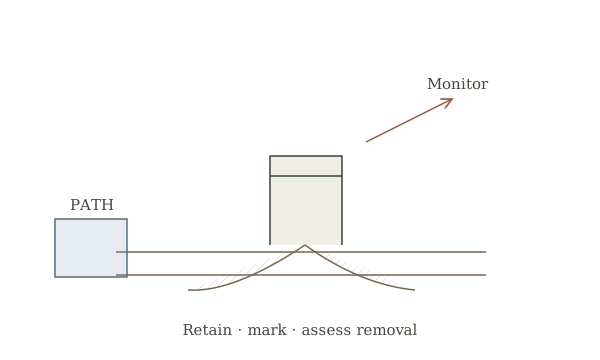
A sound low stump away from traffic may be left to decay and offer habitat. Keep a visible boundary so people do not trip, and review local fire and pest concerns. Do not bury fresh woody material under a path or build over uncertain roots.
- 04
Plan removal with a professional
If the stump obstructs a path, poses a hazard or requires grinding or extraction, obtain a qualified assessment. Identify utilities, nearby roots to retain, soil disturbance and the intended final grade. Removing visible wood does not prove all roots are gone or stop every species from resprouting.
- 05
Monitor the follow-up
Record sprouts, settling ground and any surface changes after treatment or decay. Manage recurring growth with species-specific local guidance; avoid repeatedly injuring nearby desirable trees while chasing roots.
Mistakes to avoid
- Assuming grinding prevents all root suckers
- Covering a stump in a walked path
- Pulling a storm-damaged root plate with improvised equipment
If it isn’t working
Shoots appear away from the stump
Confirm whether they arise from lateral roots and request species-specific control advice.
Ground sinks after decay
Fence or mark the depression and assess suitable fill and drainage before reopening a route.
Then & now
Historical context
Older properties often left stumps to decay or reused their wood. Modern choices weigh access, habitat, utilities, invasive species and future planting.
The modern equivalent
Professional stump grinding and local invasive-plant plans address sites that cannot safely retain a stump.
Sources & review
Editorial draft — specialist review pending. Written 2026-09-28. Sources support the stated scope; this page has not been professionally certified.
- University of Minnesota Extension — Controlling unwanted trees and shrubs ↗
Species-dependent stump and root regrowth. Checked 2026-09-28.
- University of Minnesota Extension — Deadwood and biodiversity ↗
Habitat value and hazard exceptions. Checked 2026-09-28.
- Penn State Extension — Tractors in the woods ↗
Stored energy and mechanized woodland hazards. Checked 2026-09-28.