Why it matters
A swale is part of a drainage system, not just a shallow ditch. Some designs convey water, some filter it and some allow infiltration where soils permit. An unplanned berm or excavation can concentrate flow, saturate a foundation or affect another property.
What you’ll need
Tools
- Site map
- Notebook
- Camera
Materials
- Existing vegetated drainage feature
Before you begin
Safety & limits
- This is a concept guide, not a construction section. Do not excavate, dam, infiltrate or redirect runoff without site-specific design and necessary approvals.
- Keep runoff away from foundations, septic systems, wells, unstable slopes and neighboring land. Stay clear of flooded channels.
Work carefully, in order
The method
- 01
Identify the catchment
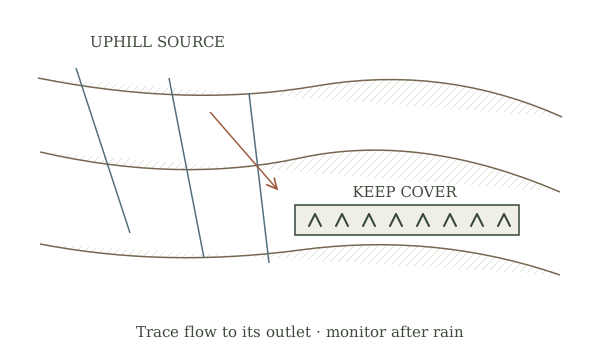
From a safe place during rain, note which roofs, paths and slopes feed the low area. Mark the inlet, vegetated reach and outlet on a map. Observe whether water is shallow and distributed or cuts a fast channel; that difference changes the design problem.
- 02
Distinguish functions
A conveyance swale carries water to a safe outlet. A water-quality swale slows flow through vegetation and may filter sediment; an infiltration swale also depends on the native soil accepting water. Do not call every depression an infiltration feature.
- 03
Check site constraints
Record nearby buildings, utilities, wells, septic areas, property boundaries and existing wetlands or streams. Note standing water after rain and any sediment at the outlet. Soil infiltration, slope and overflow path require testing and design rather than visual guessing.
- 04
Protect the existing channel
Keep vegetation established and remove only ordinary surface litter where lawful and safe. Do not deepen or line an existing swale casually; changing its section or outlet may accelerate erosion or shift flooding downstream.
- 05
Seek a designed response
If water ponds, erodes, reaches a structure or crosses a boundary, bring the observations to a stormwater or conservation professional. A design needs both routine-flow treatment and a safe route when a larger storm exceeds its capacity.
Mistakes to avoid
- Treating an infiltration swale as suitable for every soil
- Building an impermeable berm without overflow planning
- Sending water across a property line
If it isn’t working
Standing water persists
Document the duration and ask for infiltration and outlet assessment; do not add a blind underdrain.
The outlet scours
Avoid further grading and request a site-specific flow and erosion assessment.
Then & now
Historical context
Shallow vegetated channels have long guided field water. Modern stormwater practice evaluates runoff volume, soil infiltration, outlets and maintenance.
The modern equivalent
Engineered stormwater models and field infiltration tests size and locate a suitable treatment system.
Sources & review
Editorial draft — specialist review pending. Written 2026-09-28. Sources support the stated scope; this page has not been professionally certified.
- Oregon State University Extension — Water-quality swales ↗
Swale functions, siting and maintenance. Checked 2026-09-28.
- Oregon State University Extension — Infiltration testing ↗
Need to assess native soil before infiltration design. Checked 2026-09-28.