Why it matters
These knots behave differently with rope surface, tension and direction. A sliding adjustment on a tent line is not a substitute for a rated progress-capture or rescue device.
What you’ll need
Tools
- Two colors of practice cord
- Illustrated source for the named knots
Materials
- Smooth post or small scrap dowels when needed
Before you begin
Safety & limits
- Low friction cord can let an adjustable hitch creep unexpectedly.
- Do not attach a person, hoist, shelter in high wind or life-support system to a practice hitch.
Work carefully, in order
The method
- 01
Prepare
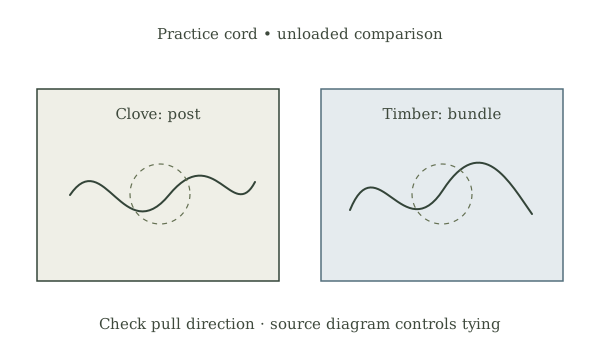
Set two low, unloaded practice lines where nobody can trip over them. Use only an unloaded sample and pause to match the cord path to the linked illustrated source before moving to the next stage.
- 02
Form
Follow the source to wrap a taut-line hitch and identify which segment slides for adjustment. Use only an unloaded sample and pause to match the cord path to the linked illustrated source before moving to the next stage.
- 03
Compare
Pull gently along the line and notice when the hitch holds or creeps on this cord. Use only an unloaded sample and pause to match the cord path to the linked illustrated source before moving to the next stage.
- 04
Inspect
Tie a rolling hitch on a second cord, comparing the direction of its extra turns with the source. Use only an unloaded sample and pause to match the cord path to the linked illustrated source before moving to the next stage.
- 05
Review
Change the direction of a light hand pull, then untie and record the direction each hitch resisted. Use only an unloaded sample and pause to match the cord path to the linked illustrated source before moving to the next stage.
Mistakes to avoid
- Using a memorized shape without checking the loaded strand and working end
- Using a practice knot for a rated, moving or human load
- Assuming all cord materials grip equally
If it isn’t working
The knot does not match the reference
Lay the cord down without tension, trace the working end from start to finish and retie from the original source illustration.
The practice knot slips or jams
Stop the hand test, note the cord surface and loading direction, and use another suitable method for a real task instead of claiming a rating.
Then & now
Historical context
Adjustable tent lines and directional hitches helped manage temporary cordage before cam cleats and purpose-built tensioners.
The modern equivalent
Purpose-built rated fittings and manufacturer-specified knots apply when a task has a defined load or safety requirement. A practice model teaches identification only.
Sources & review
Editorial draft — specialist review pending. Written 2026-09-24. Sources support the stated scope; this page has not been professionally certified.
- Animated Knots by Grog — Taut Line And Rolling Hitches ↗
Illustrated tying sequence, distinct intended application and limits; follow the linked primary instructional source. Checked 2026-09-24.
- Animated Knots by Grog — Taut Line And Rolling Hitches ↗
Illustrated tying sequence, distinct intended application and limits; follow the linked primary instructional source. Checked 2026-09-24.