Why it matters
A trail is a route for people, animals or equipment and an unintended route for water when its surface becomes a channel. Routine observations catch small faults before rutting expands. Private footpaths and livestock lanes have different loads and need different designs.
What you’ll need
Tools
- Notebook
- Camera
- Hand tools for light debris
Materials
- Existing path
Before you begin
Safety & limits
- Close or avoid an unstable, flooded or storm-damaged section. Do not work beneath hanging branches, near utility lines or on a steep eroding edge.
- Obtain permission for public or shared trails. Culverts, bridges, structural steps and drainage changes require qualified design and any applicable approval.
Work carefully, in order
The method
- 01
Walk the route in both directions
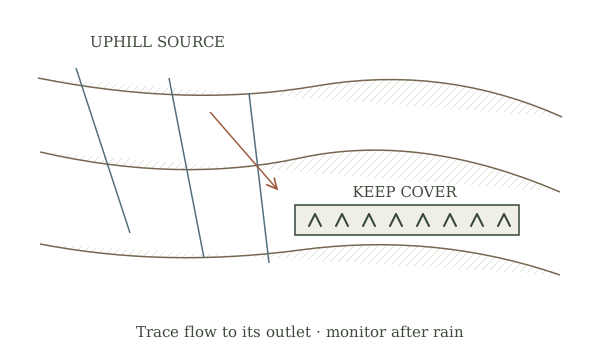
Note soft ground, slick surfaces, exposed roots, loose stones, widening around a puddle and places where water follows the tread. Mark each location on a sketch. Look uphill for the water source and downhill for where sediment will go.
- 02
Choose a small maintenance scope
For a low-use private path, remove loose litter and minor obstructions by hand without stripping stabilizing roots or opening a new shortcut. Keep the walking line clear and preserve the vegetation at its edges. Stop if a feature is carrying concentrated runoff or needs excavation.
- 03
Keep water from riding the path
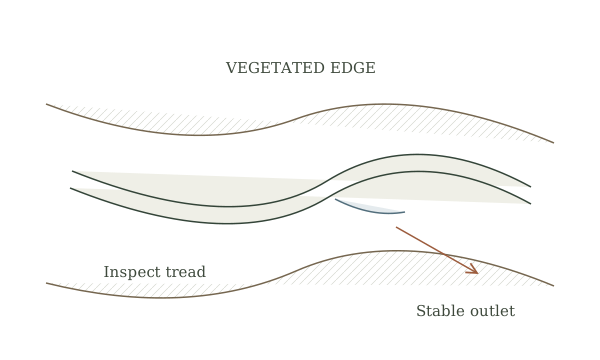
Observe whether a natural cross slope still sheds rain rather than trapping it. Clear leaves from an existing, approved outlet only when the discharge is stable and does not create a new erosion problem. Do not dig a water bar or cut a new channel from a generic diagram.
- 04
Protect wet ground
Temporarily reroute use on an already approved route or close the path when saturated soil cannot bear traffic. Avoid filling a persistent wet spot with random gravel; it can sink into mud or move the problem. Ask for site-specific surfacing or drainage advice.
- 05
Record and revisit
Photograph repaired and unresolved points. After the next rain, check whether the tread is drier, whether edges are widening and where water exits. Escalate recurring rutting, livestock traffic damage or an unsafe crossing to the land manager.
Mistakes to avoid
- Clearing too much edge vegetation
- Creating an informal bypass through habitat
- Redirecting trail runoff into a stream or adjacent property
If it isn’t working
The same rut returns
Investigate water source and traffic load; a surface patch alone is unlikely to last.
A branch blocks the route
Assess overhead and stored-energy hazards first. Leave heavy, suspended or tensioned wood to trained crews.
Then & now
Historical context
Working paths were maintained by repeated local repair. Current trail stewardship considers soil, slope, access, habitat and the flow of water beyond the path.
The modern equivalent
A mapped inspection log and site-designed drainage or surfacing plan support larger trail networks.
Sources & review
Editorial draft — specialist review pending. Written 2026-09-28. Sources support the stated scope; this page has not been professionally certified.
- Penn State Extension — Trails and walkways ↗
Soil, slope, livestock use and maintenance considerations. Checked 2026-09-28.
- Penn State Extension — Forest stewardship: watershed management ↗
Drainage as a central erosion-control concern. Checked 2026-09-28.
- Penn State Extension — Planning for beauty and enjoyment ↗
Trail siting and regular inspection. Checked 2026-09-28.