Why it matters
A single broken strand, loose staple or hidden gap can turn a fence into an animal hazard. Inspection is different from repair: it identifies damaged sections, the likely cause and the urgency before anyone handles stored tension or energised components.
What you’ll need
Tools
- Notebook
- Camera
- Fence map
- Binoculars
Materials
- Temporary marker for unsafe sections
Before you begin
Safety & limits
- Treat every wire as potentially tensioned and every electric fence as live until the system is isolated and verified by trained personnel. Do not touch fallen wires.
- Keep livestock away from an unsafe section. Storm-damaged trees, roads and power lines require the relevant utility or emergency service.
Work carefully, in order
The method
- 01
Plan a safe perimeter walk
Choose daylight and a route on stable ground. Locate gates, public edges, water crossings and known trouble spots on the map. Tell someone where you are going when the boundary is remote; do not approach a downed power line or lodged tree.
- 02
Look from a safe distance
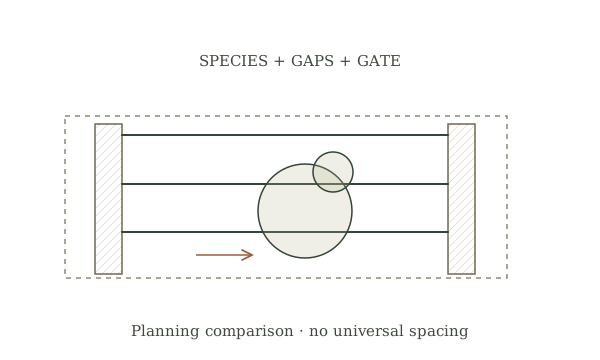
Scan each run for sag, broken strands, protruding cut ends, loose staples, fallen branches and vegetation against electrical conductors. Observe from the side rather than pulling wire to test it. Photograph and mark the location of each defect.
- 03
Examine posts and corners visually
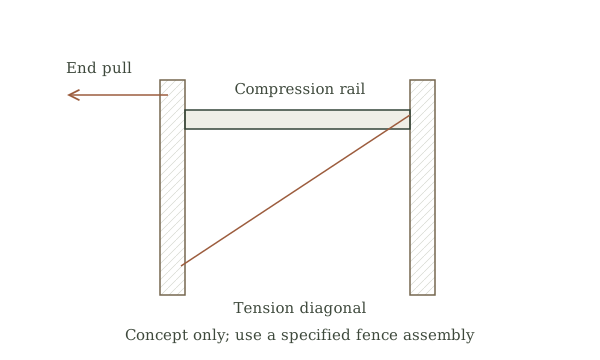
Check whether line posts lean, brace assemblies shift or ground erodes at the base. Look for rust, rot and missing insulators. Note that sag near a corner can be a support problem, not simply a wire-tension problem.
- 04
Prioritize containment
Classify gaps by animal size, road exposure and access to hazards. Move animals to a verified sound enclosure or install a suitable temporary barrier under farm guidance. Keep people and pets away from sharp ends and energized sections.
- 05
Hand off the repair
Give a repairer the location, system type, photographs and suspected cause. Have trained personnel isolate electricity and release tension using manufacturer procedures. Walk the line again after repair to confirm the enclosure is continuous.
Mistakes to avoid
- Pulling a wire to judge tension
- Walking beneath storm-damaged limbs
- Assuming a visible gap is the only failure
If it isn’t working
Damage recurs at one point
Look for stock pressure, vegetation, flood debris or a failed brace before simply replacing wire.
An electric line appears dead
Have a trained operator test the energizer, grounding and conductor as a system; visual inspection cannot prove it is safe.
Then & now
Historical context
Routine boundary walks have long been part of pasture care; modern systems add energizers, rated fittings and documented maintenance.
The modern equivalent
Mapped inspection logs and compatible test equipment support a planned maintenance schedule.
Sources & review
Editorial draft — specialist review pending. Written 2026-09-28. Sources support the stated scope; this page has not been professionally certified.
- Penn State Extension — Fencing ↗
Fence types, intended livestock use and maintenance. Checked 2026-09-28.
- University of Minnesota Extension — Fall and spring pasture to-do lists ↗
Fence inspection before grazing. Checked 2026-09-28.