Why it matters
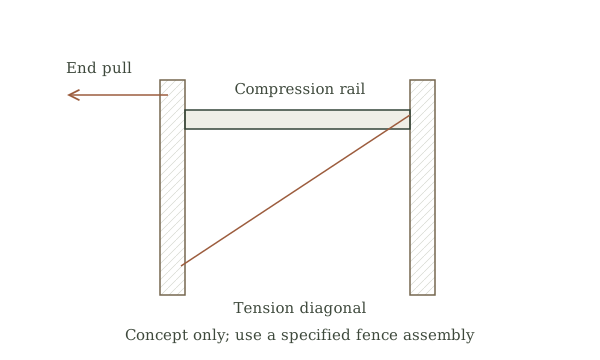
A taut fence pulls on its end posts continuously. Adding a thicker line post does not necessarily create a stable end. A brace assembly makes a load path through compression members, tension elements, and foundations; every connection participates.
What you’ll need
Tools
- Tape measure
- Level
- Notebook
Materials
- Fence system diagram
Before you begin
Safety & limits
- This is structural literacy, not a rated fence design. High-tension wire can recoil violently.
Work carefully, in order
The method
- 01
Identify loaded posts
Mark corners, ends, changes in slope, and gate openings on a fence sketch. Draw arrows for each wire run pulling on the assembly. Distinguish a light garden fence from a high-tension agricultural system before choosing a detail.
- 02
Read an approved assembly
Use the fence manufacturer’s or local agricultural engineer’s bracing specification. Identify which member is in compression and which element acts in tension. Different H-brace and diagonal systems are not interchangeable sketches.
- 03
Check the foundations
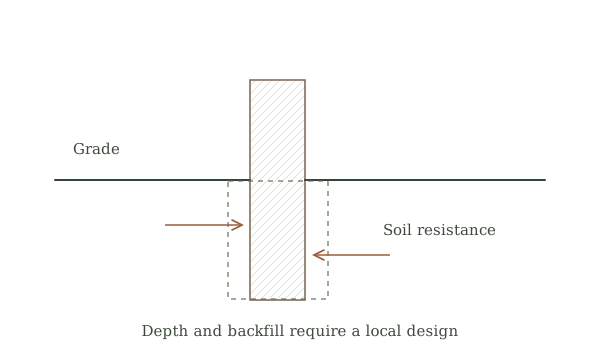
Confirm that post depth, soil capacity, span, and connections match the chosen system. Installing a brace on shallow or decaying posts merely transfers the failure elsewhere. Do not add tension to compensate for a leaning foundation.
- 04
Inspect before tensioning
Check fasteners, timber condition, anchors, and clear working space. Tensioning wire stores energy and should follow the supplier’s method with appropriate tools and eye protection. Keep other people outside the recoil path.
- 05
Reinspect in service
Look for post movement, loosened joints, corrosion, and wire no longer supported as intended. Compare to dated photographs. Remove animals from an unsafe enclosure and obtain competent help before releasing or retensioning a damaged system.
Mistakes to avoid
- Copying diagonal direction without understanding forces
- Treating a gate post like a line post
- Overtensioning to correct sag
If it isn’t working
Corner leans inward
Assess soil and brace failure before adjusting wire.
Brace loosens repeatedly
Check connection design and seasonal movement.
Then & now
Historical context
Braced agricultural fences made long wire runs practical by distributing loads into an assembly rather than one post.
The modern equivalent
Proprietary fence systems provide installation details and compatible tensioning hardware.
Sources & review
Editorial draft — specialist review pending. Written 2026-09-20. Sources support the stated scope; this page has not been professionally certified.
This entry describes general practice. A topic-specific source review is still required before it can be marked reviewed.
How this manual handles evidence →