Why it matters
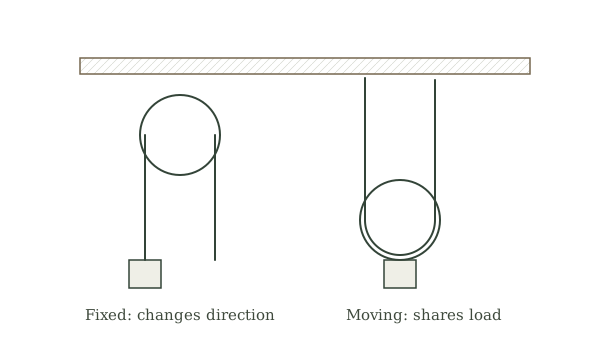
A fixed pulley changes pull direction. A moving pulley can share the load between rope segments, reducing ideal effort while increasing the rope distance pulled. Friction, angles, anchors, and hardware ratings determine what a real system can do.
What you’ll need
Tools
- Small demonstration pulley
- Cord
Materials
- Very light demonstration weight
Before you begin
Safety & limits
- No human suspension, rescue, or heavy-load rigging instructions are provided. Real lifting needs competence and rated equipment.
Work carefully, in order
The method
- 01
Start with a model
Use a light object close to a table, with a setup that cannot fall on anyone. Keep fingers away from pulley pinch points. This is a mechanics demonstration, not a method for lifting a person, engine, roof beam, or log.
- 02
Trace the fixed pulley
Route the cord over a fixed pulley and draw the load on one end and the pull on the other. In an ideal frictionless example, the effort is not halved. The support can experience forces from both loaded rope segments.
- 03
Trace a moving pulley
In a suitable demonstration model, support the moving load with two rope segments. Pulling more rope raises the load a shorter distance. Count segments supporting the moving assembly rather than counting every wheel in sight.
- 04
Include real losses
Compare the ideal model with friction, angled ropes, and a starting load. A knot reduces rope strength; unknown cord and homemade anchors have no dependable working-load rating. Mechanical advantage can overload supports while the hand force still feels modest.
- 05
Transfer the lesson safely
For real lifting, use rated compatible equipment and competent planning that covers total load, supports, inspection, control, and exclusion zones. Never stand beneath a suspended load. If you cannot establish a component’s rating, it does not belong in the lifting system.
Mistakes to avoid
- Counting pulleys instead of support segments
- Assuming easy pulling means low anchor force
- Using decorative hardware for lifting
If it isn’t working
Model needs more effort than expected
Look for friction and misalignment.
Real load moves unpredictably
Stop; a tabletop lesson is not a lifting plan.
Then & now
Historical context
Block and tackle helped people move loads with available muscle power, but did not eliminate the need for strong supports.
The modern equivalent
Rated hoists and professionally planned lifting systems provide documented limits.
Sources & review
Editorial draft — specialist review pending. Written 2026-09-20. Sources support the stated scope; this page has not been professionally certified.
- HSE — planning lifting operations ↗
Supporting reference; see the original for its complete procedure. Checked 2026-09-20.