Why it matters
Darning replaces missing fabric with interlaced threads. The repair needs sound material around the hole and enough flexibility to move with the garment. A dense stiff patch can be uncomfortable even if it looks tidy.
What you’ll need
Tools
- Darning needle
- Scissors
- Darning mushroom
Materials
- Matching yarn
- Worn sock
Work carefully, in order
The method
- 01
Assess the fabric
Wash and dry the garment first. Examine the area around the hole; if it is very thin, the repair must extend into stronger cloth. Choose yarn similar in thickness and compatible with the washing method.
- 02
Support without stretching
Place a darning mushroom or smooth support inside the sock. Hold the fabric in its natural shape rather than stretching the hole wide. Trim only loose ends that interfere; avoid cutting away useful surrounding loops.
- 03
Lay the first direction
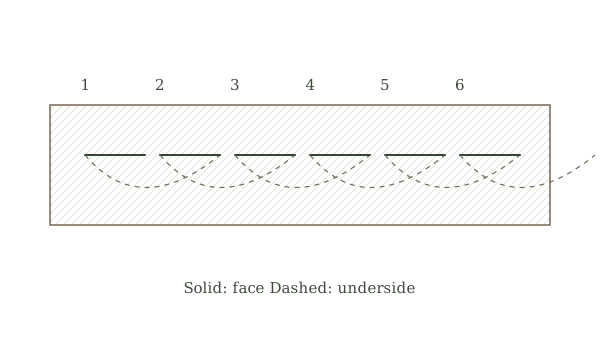
Anchor beyond the worn area and lay parallel strands across it, catching sound fabric at each edge. Leave small ease loops at turns so the repair is not pulled tight. Keep spacing regular and cover beyond the hole’s immediate border.
- 04
Weave across
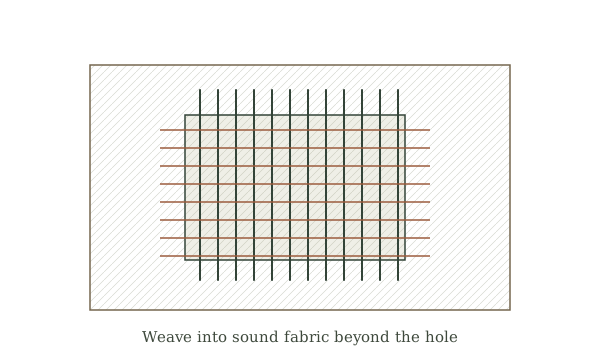
Work perpendicular to the first strands, alternating over and under. Reverse the sequence on the next pass to create a small woven field. Keep the weave open enough to flex and distribute the edge into surrounding sound fabric.
- 05
Finish and wear-test
Secure ends without a bulky knot under the foot. Remove the support and gently shape the sock. Try it on briefly; if the patch creates a pressure point, reduce bulk or use a different repair method.
Mistakes to avoid
- Anchoring in rotten surrounding cloth
- Stretching the hole during repair
- Making a hard knot under the foot
If it isn’t working
Patch pulls at the edges
Add ease and extend into sound fabric.
Repair is uncomfortable
Use finer yarn and a less dense weave.
Then & now
Historical context
Darning conserved knitted garments when replacement required considerable material and labor.
The modern equivalent
A sewn patch may suit heavy workwear, while knitted repairs can better match some fabrics.
Sources & review
Editorial draft — specialist review pending. Written 2026-09-20. Sources support the stated scope; this page has not been professionally certified.
This entry describes general practice. A topic-specific source review is still required before it can be marked reviewed.
How this manual handles evidence →