Why it matters
An icehouse stores a finite reserve of cold. Reading its sections explains why location, insulation, limited access and drainage mattered together. This historical study is distinct from validating a refrigerator or reconstructing a buried chamber.
What you’ll need
Tools
- Notebook and pencil
- Publicly available plans or site interpretation
- Camera, where photography is permitted
Materials
- A documented heritage-site record
- Simple section drawing
Before this skill
- Shed Planning Principles
Before you begin
Safety & limits
- Use records or an authorised public visit. Do not enter closed chambers, pits, tunnels or unstable ruins, and do not harvest ice from frozen water. Reconstruction involves excavation and structural hazards. Historical ice and storage conditions are not validated food-preservation methods; use current safe refrigeration for food.
Work carefully, in order
The method
- 01
Choose a documented example
Start with a named site and its official record. Note the date, recorded use and evidence for alterations. Separate measured or documented features from missing roof details and conjecture. Respect barriers and access rules if visiting; a photograph from a public path is enough.
- 02
Trace the seasonal cycle
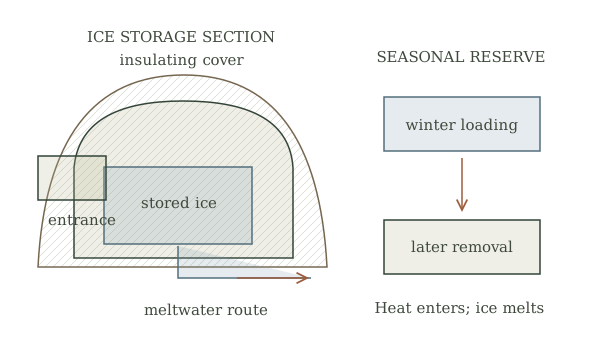
Sketch winter collection, loading, storage and later removal as separate activities. Ice carries a stored cooling reserve and gradually melts as heat enters. Record who supplied the ice and how it reached the chamber when the record explains this; do not invent undocumented machinery.
- 03
Label heat-entry routes
On a section, mark the roof, walls, ground and entrance. Document any recorded earth cover, insulated roof or entrance arrangement. Consider how opening the entrance admits warmer air. Compare examples qualitatively; the sketch cannot predict how long a store would last.
- 04
Follow the meltwater
Identify the documented floor and outlet route where evidence exists. In Weston Park, the record describes drainage associated with loading and melting. Mark missing or blocked routes as unknown. Do not clear a historic drain or enter a pit to investigate it.
- 05
Write a comparison sheet
List each feature, its proposed function and the evidence supporting that interpretation. Compare historical ice storage with controlled modern refrigeration: the latter needs monitored temperatures and food hygiene. For conservation or reconstruction, request heritage consent and qualified structural and drainage advice.
Mistakes to avoid
- Assuming underground space generates cold
- Treating a cool chamber as safe food storage
- Copying one historic plan without site evidence
If it isn’t working
The record leaves a feature unexplained
Label it uncertain and ask the site curator; keep interpretation distinct from measured evidence.
A ruin looks accessible
Stay outside barriers and report concerns to the responsible site team; never explore a confined or unstable chamber.
Then & now
Historical Method — Modern Safety Practices Differ
Historical context
At Killerton, winter ice was gathered from nearby water and stored for later use. Surviving icehouses differ in shape and operation; a documented example is more informative than assuming every estate used the same design.
The modern equivalent
Heritage interpretation and professionally assessed conservation; monitored refrigeration for current food storage.
Sources & review
Editorial draft — specialist review pending. Written 2026-09-30. Sources support the stated scope; this page has not been professionally certified.
- Historic England — Square Icehouse in Weston Park ↗
One documented icehouse, including insulation and meltwater drainage; examples vary. Checked 2026-09-30.
- National Trust — Killerton Garden ↗
Documented winter harvesting and storage at Killerton, not a food-safety standard. Checked 2026-09-30.