Why it matters
Jam uses crushed or chopped fruit while jelly begins with juice; the recipe's ingredient balance and processing method determine texture and safe storage. A set gel is not evidence of a sound seal or a safe shelf-stable product.
What you’ll need
Tools
- Current tested recipe
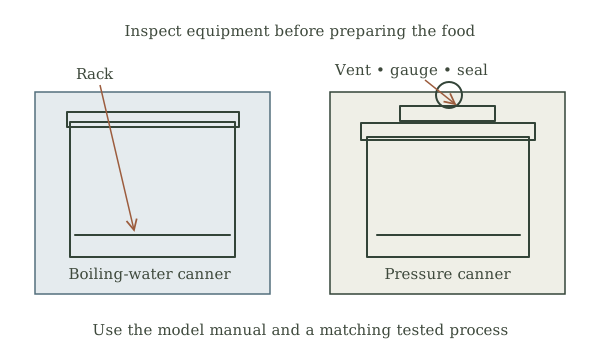
- Suitable canner
- Jar lifter
- Clean jars and new lids
Materials
- Fruit and ingredients specified by the recipe
Before this skill
- choosing-tested-preservation-recipes
- canner-equipment-check
- kitchen-hygiene
Before you begin
Safety & limits
- Follow a current tested recipe exactly, including fruit preparation, acidity, sugar or alternative pectin and altitude-adjusted processing. Do not invent batch ratios or times.
- Paraffin or an unprocessed jar is not a safe shelf-stable seal. Discard the entire jar if mold or spoilage appears.
Work carefully, in order
The method
- 01
Choose jam or jelly
Decide whether the source recipe starts with prepared fruit or extracted juice, then select a tested recipe for that fruit and exact form. Check its yield and equipment list.
- 02
Read before heating
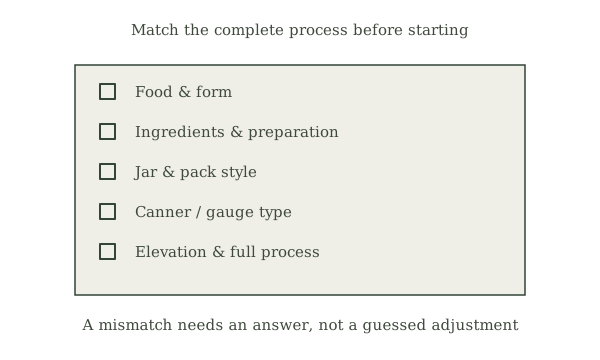
Confirm each ingredient, approved substitutions, jar size, headspace, processing method and altitude adjustment from the source. Prepare the canner and sound jars as directed.
- 03
Measure and prepare
Wash and prepare fruit according to the source; measure rather than estimate sugar, pectin and acid. Do not double a recipe or reduce sugar unless a validated low-sugar formulation explicitly allows it.
- 04
Cook and process as published
Follow the tested cooking endpoint and filling sequence, then process jars using the source's method. A gel test alone does not replace processing or prove a jar has sealed.
- 05
Check and store
Cool jars undisturbed, test seals on the schedule in the source and label the batch. Refrigerate or reprocess an unsealed jar only as current guidance permits; discard a spoiled or moldy product.
Mistakes to avoid
- Replacing sugar in a standard recipe without an approved formulation
- Using wax as a storage seal
- Scooping mold from a jar
If it isn’t working
The gel is too soft
Consult the tested source's troubleshooting; do not improvise a second shelf-stable processing schedule.
A lid does not seal
Follow current NCHFP guidance for refrigeration or reprocessing rather than storing it on a shelf.
Then & now
Historical context
Fruit preserves helped extend a seasonal harvest. Modern tested recipes replace wax seals and casual ingredient changes with specific processing and storage guidance.
The modern equivalent
Refrigerator and freezer fruit spreads use different tested formulations and storage rules from shelf-stable canned jam.
Sources & review
Editorial draft — specialist review pending. Written 2026-09-27. Sources support the stated scope; this page has not been professionally certified.
- National Center for Home Food Preservation — Jams and Jellies ↗
Supporting primary guidance; use the source's complete current process. Checked 2026-09-27.
- National Center for Home Food Preservation — Jams and Jellies FAQs ↗
Supporting primary guidance; use the source's complete current process. Checked 2026-09-27.
- National Center for Home Food Preservation — Storing Home-Canned Jams and Jellies ↗
Supporting primary guidance; use the source's complete current process. Checked 2026-09-27.