Why it matters
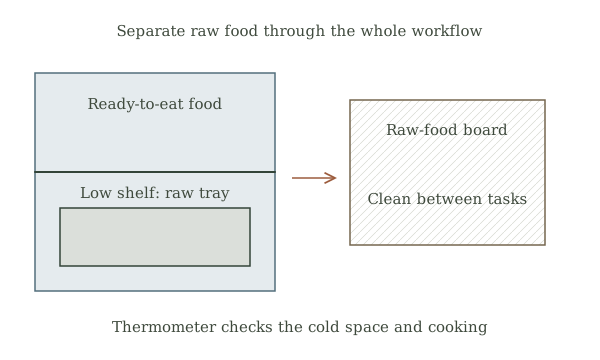
Contamination can travel on a hand, a board or the handle of a cupboard. A useful kitchen routine follows those contacts instead of judging cleanliness by appearance. Planning where food and used equipment go is especially valuable when several people share a small workspace.
What you’ll need
Tools
- Separate cutting boards
- Cleaning brush
- Timer
Materials
- Potable running water
- Soap
- Clean towels
- Food-contact surface sanitizer
Before you begin
Safety & limits
- Use sanitizers only as labeled for food-contact surfaces, including dilution, contact time and rinsing requirements. Never mix cleaning products.
- Cleanliness does not replace safe cooking or temperature control. Do not taste food to decide whether contamination has made it unsafe.
Work carefully, in order
The method
- 01
Plan the work before opening packages
Put the recipe where it can be read without touching it repeatedly. Clear a space for ready-to-eat ingredients and a separate place for raw meat equipment. Decide where dirty utensils will wait. Put a waste container within reach and remove unrelated items from the worktop. This prevents a mid-task search from spreading raw juices onto handles or drawer contents.
- 02
Wash hands at the transitions
Wash with soap and running water for at least 20 seconds, then dry on a clean towel. Repeat after handling raw animal foods, waste or pets, and before returning to clean work. Gloves do not make contaminated hands or tools safe: change the task, clean your hands and replace contaminated gloves rather than continuing across the kitchen.
- 03
Prepare produce and raw foods separately
Rinse ordinary fresh produce under potable running water before cutting; do not add soap or bleach. Keep a dedicated board and utensils for raw meat, poultry or seafood. Do not wash raw meat or poultry, since splashes spread contamination. Put cooked food onto a clean plate, never the plate that held it raw.
- 04
Clean first, then sanitize appropriately
Remove food debris and wash the surface with detergent and water before applying a suitable food-contact sanitizer. Follow that product’s instructions exactly and allow the required contact time. Clean the places touched during preparation, including taps and appliance handles. Replace a dirty cloth instead of using it to distribute residue onto the next surface.
- 05
Close the job with storage and a reset
Return perishable ingredients to cold storage promptly. Portion leftovers into shallow containers and refrigerate without leaving them out to become completely cold. FoodSafety.gov gives a two-hour limit outside refrigeration, shortened to one hour above 32°C/90°F. Then wash used equipment and leave the sink and preparation area ready for the next task.
Mistakes to avoid
- Using the same towel on hands, raw spills and clean dishes.
- Spraying sanitizer onto food residue without first cleaning.
If it isn’t working
Raw juices reached ready-to-eat food
Discard the contaminated ready-to-eat food. Clean and sanitize affected equipment before continuing.
The work area keeps becoming cluttered
Reduce the batch size and separate preparation into stages. Keep unused perishables refrigerated while each stage is completed.
Then & now
Historical context
Household manuals often emphasized orderly kitchens. Modern microbiology explains why order matters: a surface can look clean while still carrying organisms that cause illness.
The modern equivalent
Dishwashers and suitable surface products reduce manual work, but separation and correctly timed handwashing remain necessary.
Sources & review
Editorial draft — specialist review pending. Written 2026-09-22. Sources support the stated scope; this page has not been professionally certified.
- FoodSafety.gov — four steps to food safety ↗
Handwashing, separation of raw food, produce washing and prompt refrigeration. Checked 2026-09-22.
- Health Canada — food safety and you ↗
Cleaning and sanitizing food-contact surfaces; food can be unsafe without an unusual smell. Checked 2026-09-22.