Why it matters
A mill changes intact grain into flour with greater surface area and different storage behavior. Milling does not cook the grain or remove contamination; fresh flour and raw dough still need appropriate handling.
What you’ll need
Tools
- Food-safe grain mill
- Clean scoop
- Lidded food-grade container
- Label
Materials
- Identified sound dry food-grade grain
Before this skill
- Kitchen Hygiene
Before you begin
Safety & limits
- Only mill grain suitable for food and for the manufacturer’s machine. Keep fingers, hair and loose clothing away from moving parts; disconnect power before cleaning.
- Flour is raw food. Do not taste raw dough or batter, and do not use a mill to make suspect moldy grain acceptable.
Work carefully, in order
The method
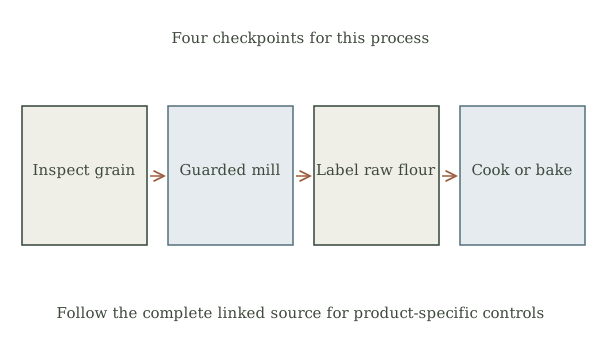
- 01
Identify and inspect
Check the grain’s identity, food-grade source, dryness and packaging. Remove obvious foreign material as the grain supplier directs; discard suspect or moldy lots rather than grinding them.
- 02
Set up the mill
Read the mill manual for grain compatibility, adjustment, cleaning and safe use. Work on a stable surface with a clean catch container, and make a small first run to check output.
- 03
Grind for the intended food
Set a grind suited to the recipe and collect the flour cleanly. If the device jams or overheats, stop and follow its manual; never reach into a running hopper.
- 04
Label and store
Record grain type and milling date, protect flour from moisture and pests, and use the source’s storage guidance. Cook or bake the flour-containing food as directed by its recipe.
Mistakes to avoid
- Grinding feed grain of unknown food-grade status.
- Treating freshly ground flour as ready to eat.
- Leaving unlabeled whole-grain flour open near heat and moisture.
If it isn’t working
The mill clogs
Switch off and disconnect power, then consult the manufacturer’s cleaning and adjustment procedure.
Flour develops an off odor or insects
Isolate and discard affected material under storage guidance; inspect grain stock and clean the mill.
Then & now
Historical context
Querns, hand mills and powered mills supplied flour near the point of use. Small lots remain practical for learning a mill’s adjustment and for reducing time that ground flour sits in storage.
The modern equivalent
A modern hand or electric mill provides adjustable flour on demand; purchased flour is a practical substitute when a mill is unavailable.
Sources & review
Editorial draft — specialist review pending. Written 2026-09-24. Sources support the stated scope; this page has not been professionally certified.
- Utah State University Extension — Food Storage Booklet ↗
Grain mills and the quality and storage differences between whole kernels and ground flour. Checked 2026-09-24.
- FDA — Handling Flour Safely: What You Need to Know ↗
Raw flour can contain pathogens and must not be tasted as dough or batter. Checked 2026-09-24.


