Why it matters
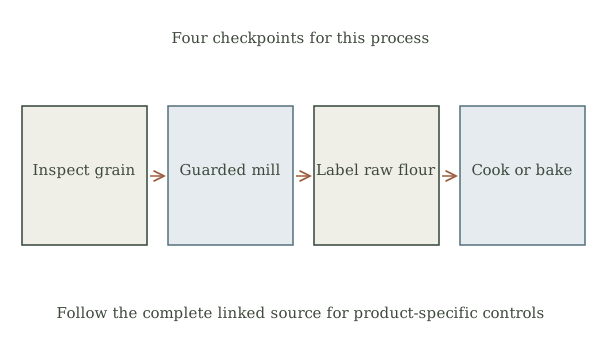
Milled whole grain exposes oils to air and can become rancid sooner than sound intact grain; cold storage slows quality loss but does not make raw flour ready to eat.
What you’ll need
Tools
- Clean airtight food container or freezer bag
- Marker
- Freezer thermometer if freezing
Materials
- Commercial or freshly milled whole grain flour
Before this skill
- Grain and Legume Storage
- Kitchen Hygiene
Before you begin
Safety & limits
- Flour is a raw food. Freezing or ordinary home storage does not make it safe to taste uncooked.
- Discard flour with visible mold, pests or a clearly rancid odor. Keep flour packages sealed and dry; do not rely on a printed date alone to decide condition.
Work carefully, in order
The method
- 01
Identify and date
Record the grain type, source or lot and milling or purchase date. Keep any original ingredient and allergen information with the new container.
- 02
Close against moisture
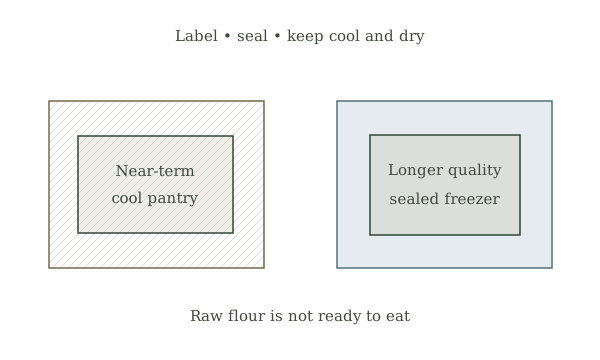
Place flour in a clean, dry, tightly sealed food-grade container. Store apart from chemicals, splashes and pests.
- 03
Choose the temperature
Use a cool dry pantry for near-term baking; for longer quality, use a well-sealed freezer bag in the freezer as advised by USU Extension.
- 04
Portion without condensation
Remove only what the recipe needs, reseal promptly, and let a closed cold package come toward room temperature before opening if condensation would otherwise reach the flour.
- 05
Inspect and cook
Check for damage, moisture, pests and off odors before use. Follow a baking or cooking recipe; do not sample raw dough or batter.
Mistakes to avoid
- Leaving milled flour open beside a warm stove.
- Allowing moisture into a cold package before resealing.
- Assuming freezing kills all pathogens in untreated flour.
If it isn’t working
A package smells stale or rancid
Discard it and store the next small batch colder and better sealed.
Insects or moisture appear
Isolate the package; inspect nearby dry goods and follow the pantry-pest response guide.
Then & now
Historical context
Storing whole grain until needed and grinding small amounts kept a household supplied with flour while limiting the time flour sat open.
The modern equivalent
Buy a smaller quantity of packaged whole wheat flour and follow the package storage directions.
Sources & review
Editorial draft — specialist review pending. Written 2026-09-24. Sources support the stated scope; this page has not been professionally certified.
- Utah State University Extension — Gearing Up for Holiday Baking ↗
Sealed cool flour storage and freezing whole wheat flour for quality. Checked 2026-09-24.
- University of Minnesota Extension — Is Flour a Food Safety Concern? ↗
Untreated flour and uncooked dough are not ready-to-eat foods. Checked 2026-09-24.