Why it matters
Canning is a heat-treatment process, not a sealing trick. The food, acidity, density, preparation, jar size, equipment, elevation, and time work together. This entry teaches how to assess a recipe; it intentionally does not provide a universal canning schedule.
What you’ll need
Tools
- Approved canner
- Jar lifter
- Timer
Materials
- Tested recipe
- Canning jars
- Compatible lids
Before you begin
Safety & limits
- No generic time or pressure is safe for all foods. Follow a complete tested process.
Work carefully, in order
The method
- 01
Choose a recognized recipe
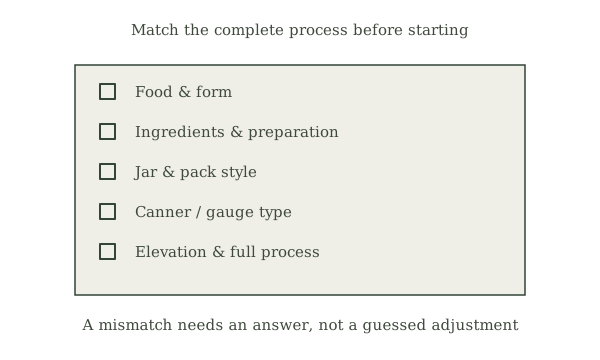
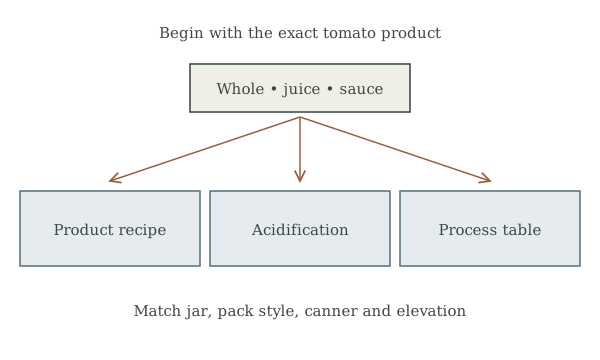
Use current NCHFP, USDA, or recognized extension guidance for the exact food and preparation. Print or save the complete instructions, including tables. A social-media recipe with many successful comments is not equivalent to a tested process.
- 02
Classify the process
Low-acid foods require a validated pressure-canning process. Water-bath canning is for suitable acid or correctly acidified foods using tested instructions. Tomatoes may require specified acidification; a sour taste is not sufficient evidence.
- 03
Match the equipment
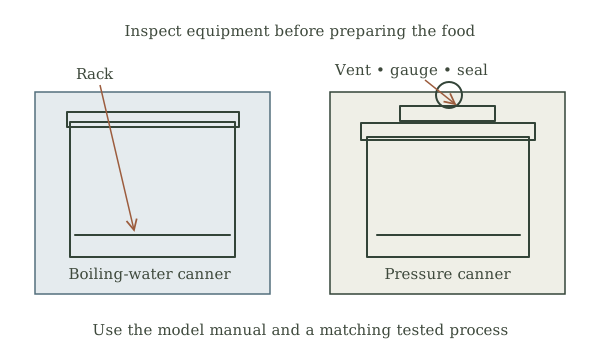
Check that your canner type, gauge, jars, and lids meet the recipe and manufacturer’s requirements. An ordinary pressure cooker is not automatically a pressure canner. Resolve gauge checks and equipment defects before starting.
- 04
Follow every control
Use the specified preparation, headspace, pack style, jar size, processing time, pressure where relevant, and elevation adjustment. Do not thicken, puree, enlarge jars, or add ingredients unless the tested guidance explicitly allows it.
- 05
Check, label, and store
Follow the prescribed cooling and seal-check procedure. Record recipe, date, and batch notes. If a step failed, use the authoritative reprocessing or disposal guidance promptly. Never taste suspect food; a sealed jar can contain unsafe food without obvious spoilage.
Mistakes to avoid
- Oven or open-kettle canning
- Water-bath canning low-acid vegetables
- Changing density or jar size casually
If it isn’t working
Jar failed to seal
Use the source’s timely reprocessing or refrigeration guidance.
You cannot reconstruct the process
Do not assume safety from appearance.
Then & now
Historical Method — Modern Safety Practices Differ
Historical context
Historic sealing methods often predate knowledge of botulism. Historical Method — Modern Safety Practices Differ.
The modern equivalent
Freezing or refrigeration may be simpler when no tested canning recipe exists.
Sources & review
Editorial draft — specialist review pending. Written 2026-09-20. Sources support the stated scope; this page has not been professionally certified.
- NCHFP — safe canned foods ↗
Supporting reference; see the original for its complete procedure. Checked 2026-09-20.