Why it matters
Quick pickles receive acid from vinegar; fermented pickles develop acid biologically. These are different processes. Pleasant sourness is not a measure of safe acidity throughout a vegetable, especially when piece size and proportions have changed.
What you’ll need
Tools
- Scale
- Measuring jug
- Suitable jars
Materials
- Sound vegetables
- Commercial vinegar of specified acidity
Before you begin
Safety & limits
- Acid ratios are safety controls. Use the full tested recipe.
Work carefully, in order
The method
- 01
Choose the storage goal
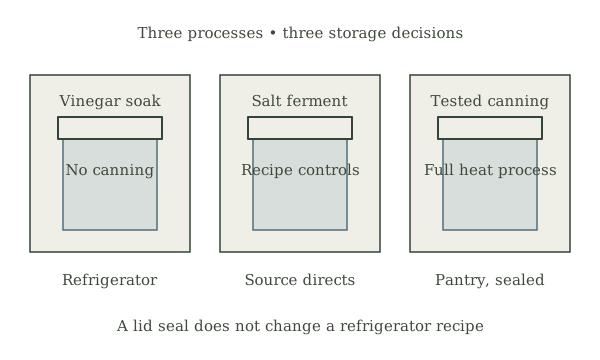
Select a tested refrigerator-pickle recipe or a tested canning recipe. Read the storage instruction first. A recipe meant for the refrigerator cannot be made shelf-stable simply by pouring it hot into a jar.
- 02
Check ingredients
Use the vinegar acidity specified by the recipe, commonly commercial 5 percent vinegar. Do not substitute homemade vinegar of unknown strength. Measure vegetables, vinegar, and water accurately, and keep the recipe’s preparation and piece size.
- 03
Prepare the batch
Wash produce and equipment. Trim and cut as directed; keep raw preparation separate from finished jars. Have the required heating or refrigeration equipment ready so the batch does not sit while you search for a missing lid.
- 04
Follow the complete method
For refrigerator pickles, use the stated cooling and refrigerator storage directions. For shelf storage, use the tested processing method, jar size, headspace, and altitude adjustment. Do not invent a shorter process because the lid has sealed.
- 05
Label and evaluate records
Mark recipe source, date, and storage requirement. If proportions were wrong or the process was interrupted, ask an extension food-preservation service before using the batch. Do not taste suspect jars to decide whether they are safe.
Mistakes to avoid
- Diluting vinegar to taste
- Substituting unknown homemade vinegar
- Assuming a vacuum seal proves safe processing
If it isn’t working
Brine is too sharp for your taste
Choose another tested recipe for the next batch; do not dilute a canning recipe.
Procedure was changed
Treat safety as unresolved and seek advice.
Then & now
Historical context
Vinegar preservation developed alongside fermented foods; modern tested recipes specify the variables that older household notes often omitted.
The modern equivalent
Refrigerator pickles are a practical small-batch option when their tested recipe and cold storage are followed.
Sources & review
Editorial draft — specialist review pending. Written 2026-09-20. Sources support the stated scope; this page has not been professionally certified.
- NCHFP — pickling principles ↗
Supporting reference; see the original for its complete procedure. Checked 2026-09-20.