Why it matters
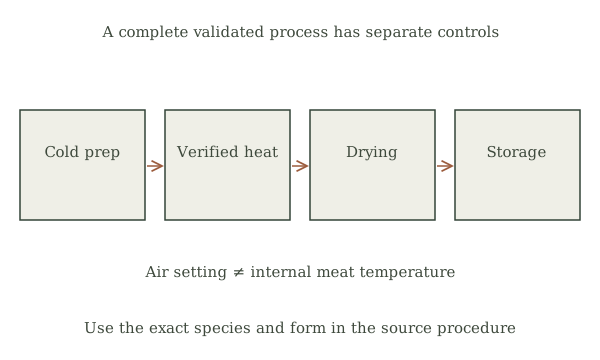
Smoke can contribute flavor and affect the surface of food, while successful cooking, curing, chilling and storage each have separate jobs. The phrase “smoked food” does not tell a reader whether the interior reached a safe cooking temperature or whether the finished food can be stored without refrigeration.
What you’ll need
Tools
- Published species-specific smoking guidance
- Suitable food thermometer
- Manufacturer manual for rated smoker
Materials
- Properly chilled food from a reliable source
- Fuel and other ingredients specified in a validated process
Before this skill
- Using Food Thermometers
- Handling Fresh Fish
- Handling Raw Meat and Poultry
Before you begin
Safety & limits
- This is equipment and process literacy, not an operational cold-smoking or curing recipe. Do not treat cold-smoked fish or meat as cooked or shelf-stable.
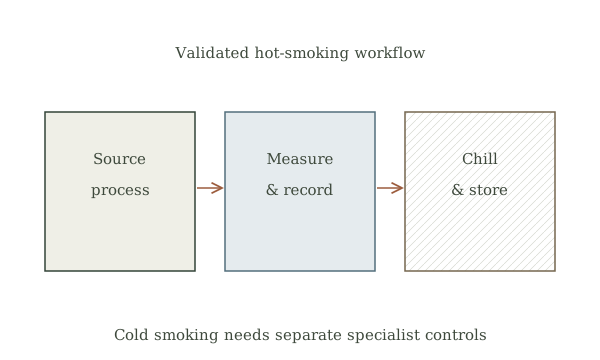
- Hot-smoked meat and poultry still need their appropriate verified cooking temperatures; use an authoritative product-specific method and thermometer. Chilling and storage instructions still apply afterward.
- Fish-smoking guidance must address species, brining, temperature, time and storage together. Use a peer-reviewed extension process for that exact fish rather than borrowing a barbecue schedule.
Work carefully, in order
The method
- 01
Define the intended product
Write whether the goal is cooked hot-smoked meat, a fish product, or a specialty cold-smoked preparation. Find an authoritative process covering the same species, form, equipment and intended storage. The adjective “smoked” alone does not describe the food-safety endpoint.
- 02
Separate heat from smoke
Review the source for internal temperature targets, how and where they are measured, and the smoker’s actual chamber conditions. A flavorful smoke stream cannot substitute for sufficient cooking of a product that requires it. Record which steps provide flavor and which control hazards.
- 03
Examine the full process
For fish, use the published extension guide’s entire set of instructions, including species preparation, any brine, equipment conditions and subsequent refrigeration or freezing. For meat and poultry, follow USDA guidance and a validated complete product process. An unmeasured homemade smokehouse or unknown cure prevents meaningful verification.
- 04
Plan cooling and storage
Before heating the smoker, arrange clean packaging and sufficient cold space for the finished batch. Follow source-specific cooling and storage instructions. A vacuum package may change risks rather than remove them, especially for fish; follow exact labeling and qualified guidance for packaging and thawing.
- 05
Defer advanced cold smoking
When a proposed process does not cook the food, its salt, moisture, temperature and storage controls need a validated specialist method. Document the historical technique as context, seek qualified training and current local rules, and select a cooked and appropriately chilled process if those controls are unavailable.
Mistakes to avoid
- Treating visible smoke or dark color as proof of adequate cooking.
- Using a hot-smoked fish schedule for another species or cold-smoked product.
- Putting a home-smoked product in a pantry because it feels dry.
If it isn’t working
The smoker lacks a trustworthy temperature reading
Use a suitable thermometer and a complete supported procedure before processing food. Do not infer heat from smoke density.
The final product will be vacuum packaged
Consult product-specific extension guidance about cold storage and thawing, particularly for fish; packaging does not establish shelf stability.
Then & now
Historical context
Traditional smokehouses used combinations of heat, salt, airflow and time suited to a place and product. Replicating their appearance in an improvised chamber does not reproduce modern controls for pathogens and storage.
The modern equivalent
Modern smoker manuals and extension publications specify food, heat, brine and storage as a connected process. Cold-smoked foods require separate qualified controls and review.
Sources & review
Editorial draft — specialist review pending. Written 2026-09-24. Sources support the stated scope; this page has not been professionally certified.
- Oregon State University Extension — Smoking Fish at Home Safely ↗
Peer-reviewed fish-specific complete smoking publication. Checked 2026-09-24.
- USDA FSIS — smoking meat and poultry ↗
Food thermometers, proper cooking and prompt chilling after smoking. Checked 2026-09-24.
- FDA — selecting and serving seafood safely ↗
Cold handling and cross-contamination considerations for fish. Checked 2026-09-24.