Why it matters
The companion principles guide explains which hazards heat, smoke, salt and chilling address. This field workflow organizes a specific approved product process before, during and after a batch; it does not invent a universal time, brine or shelf life.
What you’ll need
Tools
- Manufacturer's smoker manual
- Chamber thermometer
- Food probe thermometer
- Batch record
Materials
- Properly chilled product specified by a complete source process
- Approved fuel
Before this skill
- hot-and-cold-smoking-principles
- food-thermometers
- handling-fresh-fish
Before you begin
Safety & limits
- Use only a current validated process matched to species, cut, equipment and storage. This guide supplies no cold-smoking recipe, curing schedule or processing numbers.
- Keep meat and fish chilled before and after processing. Smoke color is not a cooking test, and cold-smoked food is not automatically cooked or shelf-stable.
- Operate a rated smoker outdoors as its manufacturer directs, with fire controls and no improvised enclosure.
Work carefully, in order
The method
- 01
Select the exact process
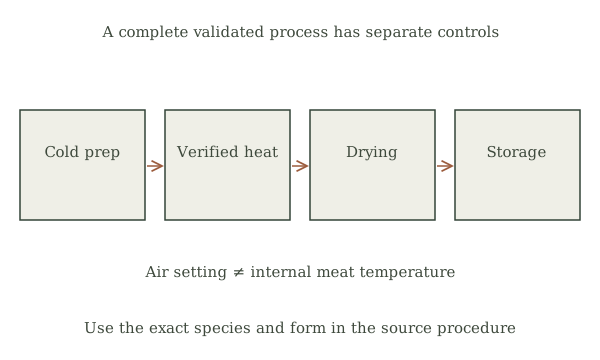
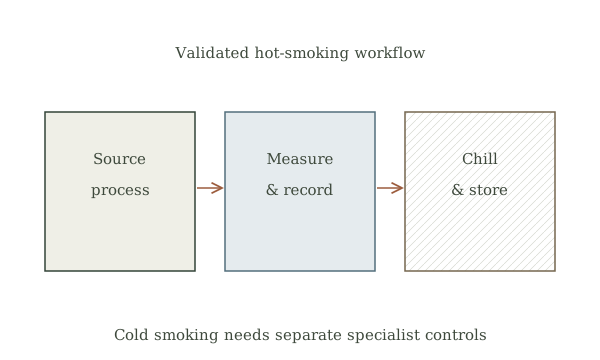
Choose an authoritative source for the specific food and intended finished product. Copy its required preparation, equipment, monitoring, cooking endpoint, cooling, packaging and storage into one batch checklist.
- 02
Prepare the equipment and food
Check the manufacturer's manual, clean food-contact parts and inspect both chamber and food thermometers. Keep raw food refrigerated during setup and avoid cross-contamination.
- 03
Run only the validated sequence
Follow the source's complete steps, monitoring chamber conditions and internal food temperature at the points it specifies. Record observations without substituting smoke density, color or elapsed time for measurements.
- 04
Stop when a control fails
If the equipment cannot meet the source's conditions, a thermometer fails or a required step is missed, do not guess a correction. Seek the source's explicit deviation guidance or discard the batch.
- 05
Cool, label and store
Follow the product-specific cooling, packaging and refrigeration or freezing instructions promptly. Mark the batch and source used; cold-smoking requires a separate professionally validated method and control plan.
Mistakes to avoid
- Borrowing a fish brine or schedule for another product
- Calling a dark exterior fully cooked
- Vacuum packing without the correct fish storage controls
If it isn’t working
The smoker cannot hold required conditions
Stop the batch and use source-specific corrective guidance; do not lengthen time by guesswork.
A cold-smoking recipe lacks verified controls
Do not make the product; obtain specialist training and a validated process.
Then & now
Historical context
Traditional smokehouses combined multiple controls, but the appearance of a historical method gives no evidence that a modern home batch is safe.
The modern equivalent
A modern rated smoker adds controls and measurements, but it cannot replace a product-specific validated food-safety process.
Sources & review
Editorial draft — specialist review pending. Written 2026-09-27. Sources support the stated scope; this page has not been professionally certified.
- USDA FSIS — Smoking Meat and Poultry ↗
Supporting primary guidance; use the source's complete current process. Checked 2026-09-27.
- Oregon State University Extension — Smoking Fish at Home Safely ↗
Supporting primary guidance; use the source's complete current process. Checked 2026-09-27.