Why it matters
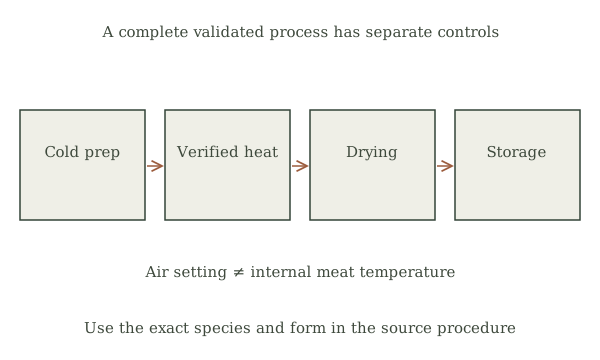
Drying draws moisture away but does not reliably kill every organism already present in raw meat. The temperature of the dehydrator air is different from the internal temperature reached by each strip. A credible procedure accounts for cut and thickness, heating, drying, packaging and storage as a complete sequence.
What you’ll need
Tools
- Complete NCHFP or other validated jerky directions
- Food thermometer appropriate to the published method
- Suitable dehydrator or oven
- Clean board and knife
Materials
- Lean meat explicitly covered by the chosen procedure
- Specified seasonings and packaging
Before this skill
- Handling Raw Meat and Poultry
- Choosing Tested Preservation Recipes
Before you begin
Safety & limits
- Use a complete research-based jerky process for the species and form of meat. Ground meat, whole-muscle strips, poultry, game and fish require different validated guidance; this page supplies no stand-alone time or temperature schedule.
- NCHFP and USDA discuss a specific internal heating step as part of safe meat jerky processing. A dehydrator’s setting, smoke flavor or marinade alone does not establish that food reached the needed internal temperature.
- Keep raw ingredients cold, marinate in the refrigerator and follow the source’s storage directions. Do not substitute outdoor sun drying or guess shelf life for a different product.
Work carefully, in order
The method
- 01
Choose a covered source
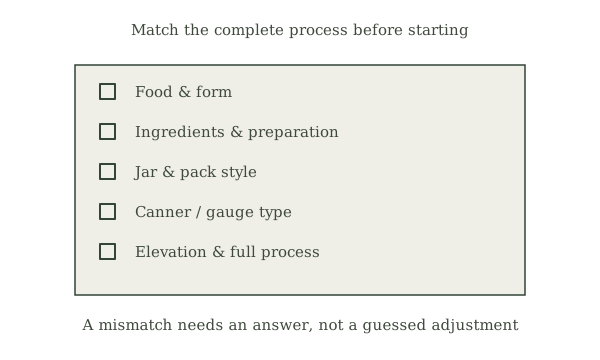
Identify whether the available food is a whole cut, ground meat, poultry, game or fish, then find a current authoritative procedure for that exact form. Read the entire page before buying equipment; note required cutting thickness, heating method, drying setup, packaging and storage. Leave fish jerky and specialty game to separate guidance.
- 02
Protect the raw-food phase
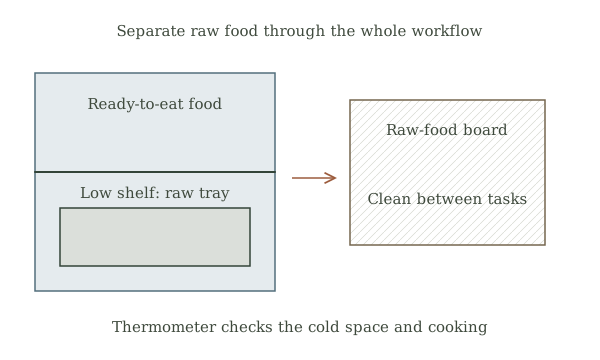
Keep meat refrigerated while preparing and marinating it and separate its board from cooked and ready-to-eat foods. Follow the source’s trimming and cutting instructions; thickness affects how safely a process can heat and dry a strip. Do not reuse raw marinade as an unheated finishing sauce.
- 03
Identify the lethality step
Locate in the published method where the meat reaches its required internal temperature and how that result is verified. NCHFP describes heating strips before or after drying under specific conditions. These are alternative complete procedures, not interchangeable numbers to mix with an unrelated recipe.
- 04
Monitor the drying stage
Follow the source for spacing strips, maintaining the equipment conditions and judging the specified end point. Surface hardening can leave the inside wetter than expected. Record measurements and deviations; if equipment cannot attain or verify its required conditions, stop rather than extending an arbitrary timer.
- 05
Cool, package and store as directed
Use the source’s cooling, packaging and storage requirements for that product. Mark batch date and source. Check for signs of rancidity, moisture or mold and discard questionable food without tasting. For meat that falls outside a validated jerky process, cook it as an ordinary refrigerated meal instead.
Mistakes to avoid
- Assuming marinade acid or smoke alone sterilizes raw meat.
- Copying a dehydrator dial setting as if it were meat internal temperature.
- Using a whole-strip process for ground meat.
If it isn’t working
The equipment cannot verify the internal heating step
Find an appropriate thermometer and follow the complete validated method or prepare a conventional cooked meal; do not claim safety from dryness alone.
A batch was cut thicker than the source specifies
Do not extrapolate time from appearance; consult the source or an extension specialist about whether the batch can be processed safely.
Then & now
Historical context
Salted, smoked and sun-dried meats have long histories. Those practices developed under differing climates and conditions. A household memory of how a strip looked at the end is not a measured modern food-safety procedure.
The modern equivalent
Modern guides describe specific heating and drying sequences. Dehydration remains a useful technique when product type and process controls actually match the validated directions.
Sources & review
Editorial draft — specialist review pending. Written 2026-09-24. Sources support the stated scope; this page has not been professionally certified.
- NCHFP — jerky ↗
Complete meat-jerky procedures including heating, thickness, drying and storage. Checked 2026-09-24.
- USDA FSIS — jerky and food safety ↗
Separate meat and poultry internal-heating recommendations and home handling. Checked 2026-09-24.
- NCHFP — general drying FAQs ↗
Limits on guarantees from a single heating step. Checked 2026-09-24.